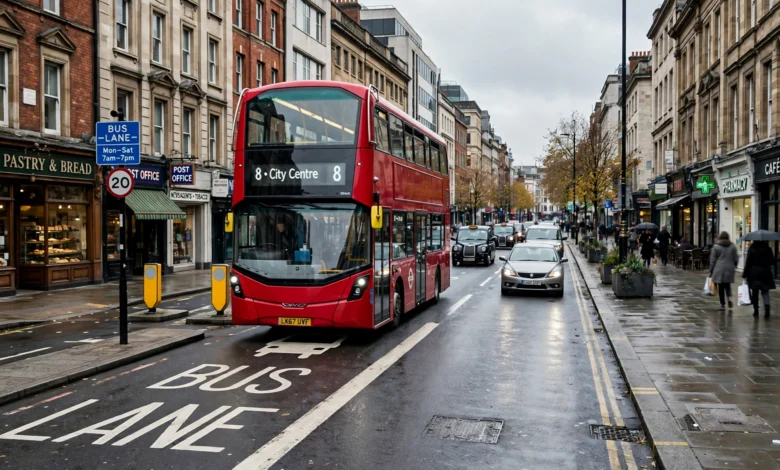
A with flow bus lane is a lane reserved for buses that travel in the same direction as the rest of the traffic on the road, and it is usually the left-hand lane of a busy town or city street. When you see one, the buses using it are going your way, not coming towards you, and the lane is there so that buses can keep moving while general traffic queues beside them. As of November 2026, the rules that govern these lanes are set out in Rule 141 of The Highway Code, and the signs that mark them are published by GOV.UK in the official Know Your Traffic Signs guidance, so the meaning of the lane has not changed and every driver in England, Scotland and Wales is expected to understand it.


This guide takes the practical view, which is what you need when you are actually behind the wheel and a blue bus lane sign appears ahead of you on a road you do not know well. It explains what the lane looks like from the driver’s seat, which vehicles are allowed in it, the hours when the restriction applies, the difference between a bus lane and a contra flow bus lane, and what happens if you drift into one at the wrong time. By the end, you will be able to read the signs in a second, make the right decision without hesitating, and avoid the penalty charge notices that catch thousands of drivers every year.
What Is a With Flow Bus Lane?
A with flow bus lane is a marked lane on the carriageway that is set aside for buses travelling in the same direction as all the other traffic, and the words “with flow” are the clue to the whole idea, because the buses flow with you rather than against you. The lane is normally on the near side of the road, which means the left-hand side in the UK, and it is separated from the general traffic lanes by a solid or broken white line and by the words BUS LANE painted on the road surface in large white letters. Rule 141 of The Highway Code states that bus lanes are shown by road markings and signs that indicate which, if any, other vehicles are permitted to use the lane, and that unless otherwise indicated, you should not drive in a bus lane during its period of operation.
The purpose of the lane is simple and practical, because buses carry dozens of people at a time and a city street works better when those people are not stuck in the same queue as every single-occupant car. By giving buses their own lane, the road lets them pass slow-moving traffic, keep to their timetables, and reach stops without weaving in and out of the general flow, which also makes the road safer because buses are not constantly pulling out and cutting back in. For a car driver, the lane is not a shortcut and it is not a spare lane to use when traffic is heavy, and treating it as either of those things is exactly how drivers end up with a fine. The lane belongs to the buses during its hours of operation, and your job is to stay out of it, watch for buses joining and leaving it, and use it only when the signs say you may.
How Do You Spot a Bus Lane on the Road?
You spot a bus lane by looking for three things working together, which are the blue sign, the road marking, and the position of the lane itself, and once you know the pattern you will recognise one from a long way off. The advance sign is a blue rectangular sign showing a white bus symbol, often with a bicycle symbol beside it, and it tells you that a bus lane is ahead and which vehicles may use it, with the hours of operation shown underneath when the lane does not run at all times. As you reach the lane, the words BUS LANE are painted on the road surface, the lane is usually the left-hand lane, and a solid white line or a broken white line separates it from the lane beside it. The GOV.UK Know Your Traffic Signs guidance shows every version of these signs, and it is worth looking at the official pictures so that the shapes feel familiar before you meet them on a real road.
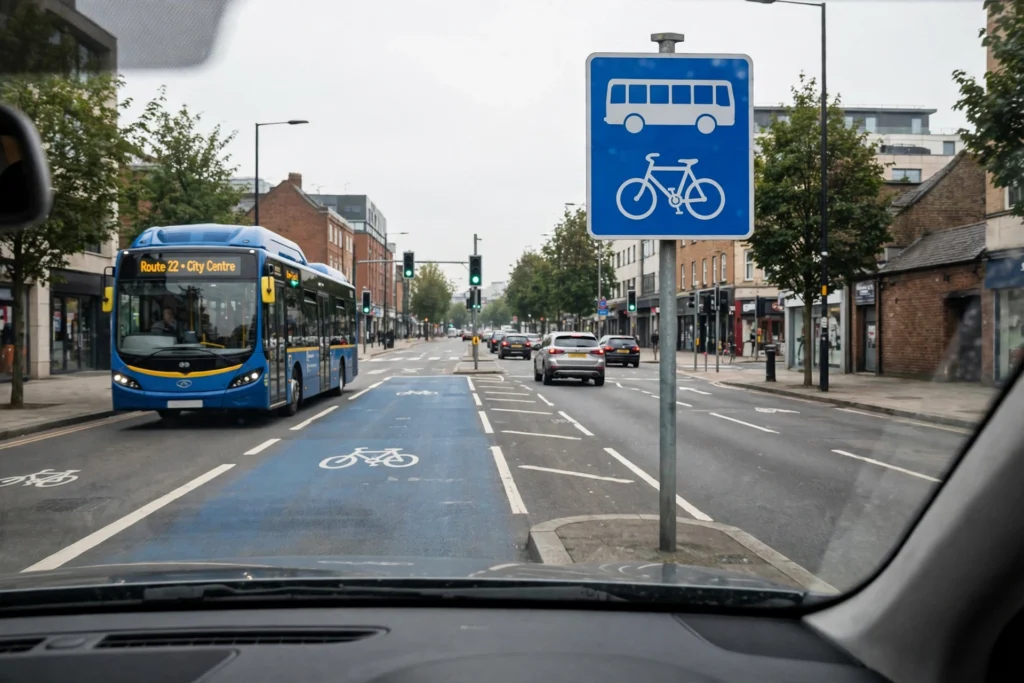
The most important detail on the sign is the small panel underneath the bus symbol, because that panel tells you when the lane is in force and which other vehicles are allowed in it. If the panel shows hours such as 7am to 7pm, the restriction applies only during those hours, and outside them the lane is open to all traffic, whereas if no hours are shown at all, the lane operates at all times and you should never drive in it. The panel may also show extra symbols for pedal cycles, taxis, or solo motorcycles, and those symbols mean those vehicles may use the lane too, but only the vehicles shown are permitted, so a symbol you do not see means a vehicle you should not assume is allowed. Reading that small panel takes only a second once you know to look for it, and it is the difference between using the road correctly and driving into a camera-enforced lane without realising it.
Who Can Use a Bus Lane?
Buses are the main users of a bus lane, and the lane is built for them first, but they are not always the only vehicles allowed in, because the signs may also permit pedal cycles, taxis, and in some places solo motorcycles or other authorised vehicles. Pedal cycles are the most common extra user, and the Traffic Signs Manual notes that a bus lane on the left-hand side of the carriageway is always available to both buses and pedal cycles unless the signs say otherwise, because it is not considered safe to force cyclists to ride in the general traffic lane where they would be squeezed between two streams of motor traffic. Taxis, meaning licensed hackney carriages, may use the lane where the order that created it permits them, and the sign will show a taxi symbol if they are allowed.
There are also finer details that catch people out, and the most useful one is the word “local” that sometimes appears on the bus symbol itself. When the sign says “local” on the bus, only buses running a local service may use the lane, but when the word “local” is not shown, the lane may be used by local buses and by any vehicle designed to carry ten or more people including the driver, according to the GOV.UK Know Your Traffic Signs guidance. Other vehicles may enter and stop in a bus lane to load or unload unless the signs alongside the lane indicate otherwise, which is a practical exception that helps shops and deliveries, but it does not give ordinary drivers a general right to drive along the lane. If your vehicle is not shown on the sign and you are not loading or unloading where that is allowed, the safe assumption is that the lane is not for you.
When Can You Drive in a Bus Lane?
You can drive in a bus lane when its hours of operation have ended, because outside those hours the restriction lifts and the lane becomes an ordinary traffic lane that any vehicle may use. This is the single most useful fact for drivers, because many bus lanes in towns and cities operate only at peak times, such as the morning and evening rush hours, and for the rest of the day the lane sits empty while traffic queues beside it for no reason. The way to know is to read the hours on the sign, and if the sign shows no hours at all, the lane operates at all times, so you should never enter it. Checking the clock against the sign takes a moment, and it is the habit that separates drivers who use the road well from drivers who either waste time in a queue or risk a fine by guessing.
There are a few other situations where entering the lane is allowed, and they are all narrow exceptions rather than general permission. You may enter a bus lane to stop, to load or unload where that is not prohibited, and you may cross it when you need to turn left at a junction, because the lane is on the left and your turn takes you across it. You may also need to move into it briefly to let an emergency vehicle pass, or to avoid an obstruction in your own lane, and in those cases the sensible thing is to move in only as far as you must and to leave the lane as soon as you safely can. What you must not do is drive along the lane for a stretch because traffic is slow, or use it to jump a queue, because cameras watch these lanes in most cities and the footage is clear about how far you travelled and for how long.
With Flow Bus Lane vs Contra Flow Bus Lane: What Is the Difference?
The difference between a bus lane and a contra flow bus lane is the direction the buses travel, because in a bus lane the buses go the same way as all the other traffic, while in a contra flow bus lane the buses travel in the opposite direction to the normal flow. A contra flow bus lane usually appears on a one-way street, where general traffic can only go one way, and the lane lets buses travel the other way so that they can still serve stops on that street without a long detour. Rule 143 of The Highway Code, which covers one-way streets, says that traffic must travel in the direction indicated by signs, and that buses and cycles may have a contraflow lane, which is the official recognition that this arrangement exists and that drivers must expect it.
You can tell the two apart by the signs, and the clue is the arrows, because a bus lane sign has no direction arrows at all, since the buses are simply going the same way as you, while a contra flow bus lane sign always shows arrows pointing in opposite directions, with the bus arrow pointing towards you. This matters in real driving because a contra flow lane means buses can appear coming towards you on a street where every other vehicle is travelling your way, and that is surprising if you are not expecting it, especially at a junction or when you are turning. The practical rule is simple: no arrows means with the flow, arrows pointing against the traffic mean contra flow, and in either case you must not drive in the lane unless your vehicle is permitted to use it.
What Happens If You Drive in a Bus Lane When You Should Not?
If you drive in a bus lane during its hours of operation when your vehicle is not permitted, you are likely to receive a penalty charge notice from the local council, because most bus lanes in UK towns and cities are enforced by cameras that record your number plate and the time you entered the lane. The council sends the notice to the registered keeper of the vehicle, and the amount is set by the local authority, so it varies from place to place, with a discount usually available if you pay promptly within the period stated on the notice. The enforcement is a civil matter handled by the council rather than a police prosecution, and it does not normally add points to your driving licence, but the fine itself is real money and repeat offences can lead to further notices, so it is worth taking seriously rather than treating it as a small risk.
The way to avoid a notice is to build a small habit rather than relying on luck, because the drivers who get caught are usually the ones who were following a sat nav, copying the car in front, or trying to save a few minutes in heavy traffic. Before you enter a lane that looks like a bus lane, check the sign for its hours and its permitted vehicles, and if you are unsure, stay out, because the few seconds you might save are never worth the cost of the notice. If you do receive a notice and you believe it was issued in error, for example because you were loading or unloading where that was allowed, or because the signs were unclear or damaged, you can challenge it through the process explained on the notice itself, and you should keep any evidence such as photographs of the signs and the time of day. Councils do cancel notices when the evidence supports the driver, but the strongest position is always the one where you never entered the lane in the first place.
How to Drive Safely Around a Bus Lane
Driving safely around a bus lane starts with looking ahead rather than looking at the car in front of you, because the blue sign and the painted road markings give you plenty of warning, and a driver who spots them early has time to choose the right lane without a sudden move. When you are driving beside a bus lane, keep a careful eye on your mirrors and your blind spot, because buses are long vehicles that need room to pull out from stops, and a bus that is leaving a stop may need to move into your lane. Cyclists may also be using the bus lane, and they can be hidden behind a bus or a queue of traffic, so check for them before you turn left across the lane, and give them the same space you would give any other road user. The Highway Code expects you to treat the bus lane as a live part of the road, not as empty space, and that attitude prevents most of the collisions that happen around these lanes.
The riskiest moment is the left turn at a junction, because your route takes you across the bus lane and you need to be sure it is clear before you cross it. Slow down early, signal in good time, check your left mirror and blind spot for a bus or a cyclist coming up behind you in the lane, and only cross when you are certain there is a safe gap. Do not swing wide or cut the corner, and do not stop in the bus lane while you wait for a gap in oncoming traffic, because a bus behind you will have nowhere to go. At night and in rain, the lane markings and the signs can be harder to read, so slow down a little and give yourself more time to read the road, and remember that the reflective studs and painted lines work together to show you where the lanes are. Our guide to amber reflective studs on a motorway explains how the stud colours help you read the road after dark, which is a useful skill on any busy route. A calm, early decision at every bus lane is the mark of a confident driver, and it keeps the buses, the cyclists and you all moving safely.
Conclusion
A with flow bus lane is a straightforward idea once you understand it, because it is simply a lane for buses travelling in the same direction as you, marked by a blue sign, the words BUS LANE on the road, and the hours of operation shown on the sign. The rules that matter most are the ones in Rule 141 of The Highway Code, which tells you not to drive in the lane during its period of operation unless your vehicle is permitted, and the signs published by GOV.UK, which tell you exactly which vehicles are allowed and when. Remember the two checks that matter every time: read the sign for its hours and its symbols, and look for the arrows that tell you whether a lane is with the flow or against it.
The practical habit is what keeps you out of trouble, and it is a small one, because all it takes is a glance at the sign, a check of the clock, and a decision made early rather than at the last second. Use the lane only when the signs say you may, cross it carefully when you turn left, and watch for buses and cyclists who are using it properly, and you will drive through every town and city without a penalty charge notice and without a near miss. The lane is there to keep buses moving and to keep the road working for everyone, and a driver who understands it is a driver who makes the road better for the people around them.
What is a with flow bus lane in simple terms?
A with flow bus lane is a lane on the road that is reserved for buses travelling in the same direction as the rest of the traffic, and it is usually the left-hand lane of a busy town or city street. The buses in the lane are going your way, not coming towards you, and the lane exists so that buses can keep moving past queues of general traffic and stay on time. You can recognise one by its blue sign showing a bus symbol, the words BUS LANE painted on the road surface, and a panel underneath the sign that shows the hours of operation and any other vehicles that are allowed to use it.
Can I drive in a bus lane outside its operating hours?
Yes, you can drive in a bus lane outside its operating hours, because the restriction only applies during the times shown on the sign, and once those hours have ended the lane becomes an ordinary traffic lane. For example, if the sign says the lane operates from 7am to 7pm, you may use it after 7pm and before 7am without breaking the rules. The important exception is that if the sign shows no hours at all, the lane operates at all times, so you must never drive in it, and you should always check the sign rather than assuming a lane is free.
Who else can use a bus lane besides buses?
Besides buses, a bus lane can usually be used by pedal cycles, and it may also be used by taxis, solo motorcycles, or other authorised vehicles where the sign shows their symbol. Cyclists are the most common extra users, because the Traffic Signs Manual explains that it is not safe to force them into the general traffic lane between two streams of motor traffic. The sign is the only reliable guide, so you should look for the symbols on the sign itself, and if a vehicle type is not shown, you should assume it is not permitted to use the lane.
How is a bus lane different from a contra flow bus lane?
A bus lane carries buses in the same direction as the rest of the traffic, while a contra flow bus lane carries buses in the opposite direction, usually on a one-way street where general traffic can only travel one way. You can tell them apart by the signs, because a bus lane sign has no direction arrows, while a contra flow bus lane sign always shows arrows pointing in opposite directions, with the bus arrow pointing against the main flow. The practical difference is that in a contra flow lane, buses can come towards you on a street where everything else is travelling your way, so you need to expect them at junctions.
What is the fine for driving in a bus lane?
The fine for driving in a bus lane is a penalty charge notice issued by the local council, and the amount is set by that council, so it varies from place to place, with a discount usually available if you pay promptly within the period stated on the notice. Most bus lanes are enforced by cameras that record your number plate, and the notice is sent to the registered keeper of the vehicle. It is a civil penalty rather than a police prosecution, and it does not normally add points to your driving licence, but it is still a real cost, and the simplest way to avoid it is to check the sign for its hours before you enter the lane.