What Colour Are the Reflective Studs Between a Motorway and a Slip Road? Green — and What to Do When You See Them

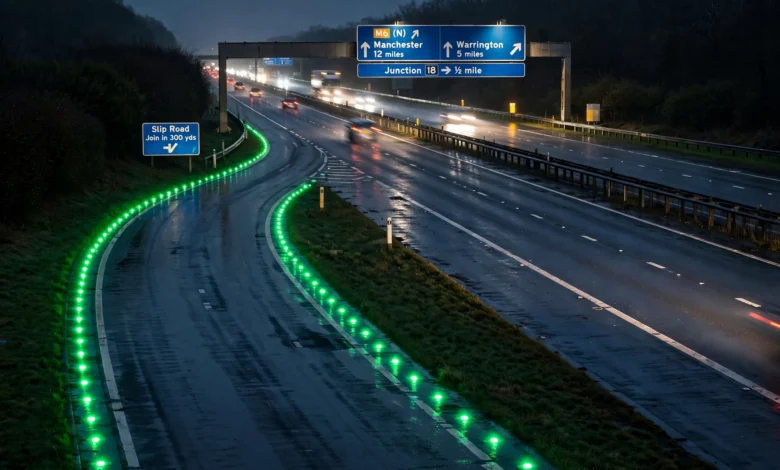
The reflective studs between a motorway and a slip road are green, and that is the short answer that every UK driver should be able to give without hesitating. Highway Code Rule 132 sets out the colour code for reflective road studs, and it states plainly that green studs mark the edge of the main carriageway at lay-bys and slip roads, which means that the line of green lights you see glowing in your headlights is the boundary where the motorway meets the road that takes you off it or brings traffic on to it. As of November 2026, this rule has not changed, and it applies across England, Scotland and Wales, so the answer is the same whether you are driving on the M1, the M6, or a short stretch of motorway near your home.

Knowing the colour is only half the job, because the real skill is knowing what to do in the seconds after you spot those green studs, and that is what this guide is for. If you have ever asked yourself what colour are the reflective studs between a motorway and a slip road? while driving home in the dark, you are not alone, because it is one of the most searched driving questions in the UK, and the answer is worth knowing properly rather than guessing. It takes the practical view of a driver on the road at night, in rain, or in heavy traffic, and it explains what green studs look like from the driver’s seat, how they fit with the other stud colours, how to use them to time your exit, how to join a motorway safely from a slip road, and what to do when the studs disappear in fog or roadworks. By the time you finish reading, the green line at the edge of the motorway will feel like a familiar landmark rather than a detail you once memorised for a test.
What Colour Are the Reflective Studs Between a Motorway and a Slip Road?
The reflective studs between a motorway and a slip road are green, and Rule 132 of The Highway Code is the official source for that answer, because it lists every stud colour and its meaning in a single short rule that is easy to check. The rule says that white studs mark the lanes or the middle of the road, red studs mark the left edge of the road, amber studs mark the central reservation of a dual carriageway or motorway, green studs mark the edge of the main carriageway at lay-bys and slip roads, and green and yellow studs indicate temporary adjustments to lane layouts, for example where road works are taking place. That one paragraph is the whole colour code, and once you have read it, the green line at a slip road makes complete sense, because it is telling you that the edge of the motorway is opening up and that traffic can leave or join there.
The reason the studs are green at a slip road is that green is the colour the Highway Code uses for movement on and off the road, and you can think of it as the colour of a gateway rather than the colour of a boundary. Red studs on your left and amber studs on your right are telling you where the road ends, and they are warnings not to cross them, while green studs are telling you where the road opens, and they are an invitation to pay attention because something is about to change. When you see a line of green studs appear on your left, it means a slip road is starting, and when the green line ends, it means the slip road has finished and the edge of the carriageway is closed again. That simple reading turns a small coloured light into a clear instruction, and it works in the dark, in rain, and in spray, which is exactly when you need it most.
What Do the Other Reflective Stud Colours Mean on a Motorway?
The other reflective stud colours on a motorway each mark a different part of the road, and learning all of them together is easier than learning green on its own, because the four colours form a complete picture of the carriageway. Most drivers who search for what colour are the reflective studs between a motorway and a slip road? already suspect the answer is green, but the full colour code is what makes the whole road readable at night, so it is worth learning the set rather than a single colour. Red studs mark the left-hand edge of the carriageway, so when you see a line of red studs on your left, you know that beyond them lies the hard shoulder or the verge, and that you should not cross them in normal driving. White studs mark the lanes or the middle of the road, so they show you where one lane ends and the next begins, and they help you hold your position in your lane when the painted lines are worn or hard to see. Amber studs mark the central reservation, which is the barrier in the middle of the motorway that separates traffic travelling in opposite directions, so a line of amber studs on your right tells you that the barrier is close beside you. Our guide to amber reflective studs on a motorway explains that colour in full, and it is worth reading alongside this article, because amber and green are the two colours that tell you the most about where you are on the road.
There is also a fifth colour combination that drivers meet less often but should still recognise, which is green and yellow studs used together, and those indicate a temporary adjustment to the lane layout, for example where road works are taking place or where a contraflow is in operation. When you see green and yellow studs, the normal layout of the road has changed, and you should follow the temporary signs, the cones, and the road markings rather than relying on your memory of how the road usually looks. A useful way to remember the whole system is to think of the colours as a map of the motorway from left to right, with red on the far left for the hard shoulder, white in the middle for the lanes, amber on the far right for the central reservation, and green wherever traffic can leave or join, which is the one colour that always means something is about to happen.
How to Read Green Studs as You Approach a Motorway Exit
As you approach a motorway exit, the first sign of it is usually the overhead gantry or the roadside sign showing the junction number and the place names, and the green studs are the confirmation that follows on the road surface itself. The green line starts where the slip road begins to separate from the main carriageway, and it runs along the edge of the motorway for the length of the slip road, so watching for it gives you a second chance to realise your exit is coming even if you missed the sign or were looking at the traffic ahead. In daylight the studs are small and easy to overlook, but at night they glow clearly in your headlights, and on a dark, wet motorway they can be the clearest signal that your junction is near. The practical habit is to check your mirrors, signal, and move into the left-hand lane in good time once you know your exit is approaching, rather than waiting until the green studs are beside you and then making a hurried move across traffic.
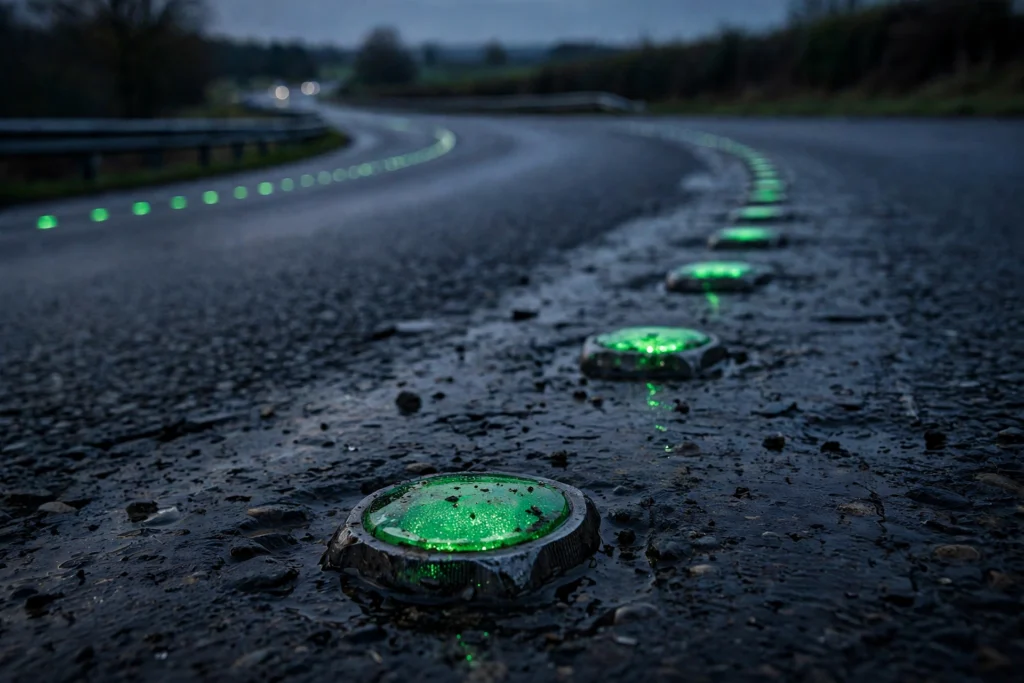
The timing matters because a motorway exit taken too late is one of the most dangerous mistakes a driver can make, and the green studs are there to help you avoid it. That is why the question what colour are the reflective studs between a motorway and a slip road? matters in real driving and not just in a theory test, because the green line is your early warning that the exit is here and that you need to be ready. If you are in the left-hand lane and the green studs are passing on your left, you are already at the start of the slip road, and you should be slowing down smoothly and following the slip road, not braking hard or swerving across lanes. If you realise you are in the wrong lane, do not cut across the chevron markings or the solid white line that separates the slip road from the carriageway, because that is both dangerous and against the rules, and it is far safer to carry on to the next junction and turn around. The studs are a guide, not a deadline, and the calm driver treats them as an early warning that the exit is here, rather than as a signal to make a sudden decision at the last possible moment.
How to Join a Motorway Safely from a Slip Road
Joining a motorway from a slip road is the mirror image of leaving one, and the green studs play the same role, because they mark the point where the slip road meets the main carriageway and where you need to merge with traffic that is already moving fast. As you drive along the slip road, build up your speed so that you are travelling at a similar speed to the traffic on the motorway by the time you reach the end of the slip road, because joining at a much slower speed forces other drivers to brake or swerve around you, and that is how collisions happen. Use your mirrors and check your blind spot early, look for a gap in the left-hand lane, and signal your intention to join so that drivers on the motorway know what you are doing. The green studs on your right as you merge are the sign that the edge of the carriageway is closing behind you and that you are now part of the main flow of traffic.
The most common mistake when joining is to stop at the end of the slip road, and you should avoid that whenever you can, because a stationary car at the end of a slip road is in a very dangerous place, with fast traffic passing beside it and nowhere safe to wait. If the traffic is so heavy that there is genuinely no gap, slow down on the slip road and keep looking for one, but keep moving if you possibly can, because a moving car can use a small gap that a stopped car cannot. Give way to traffic already on the motorway, because they have priority, but do not assume they will always make room for you, and be ready to adjust your speed to fit into the gap you have chosen. Once you have joined, stay in the left-hand lane until you are settled, build up to the motorway speed limit if conditions allow, and only then think about moving out to overtake, because a rushed lane change in the first few seconds after joining is a common cause of near misses.
What Green Studs Mean at a Lay-by
Green studs also mark lay-bys, which are the small stopping areas set into the side of a motorway or a dual carriageway, and the meaning is the same as at a slip road, because the green line is telling you that the edge of the carriageway is opening and that a vehicle can leave the main flow of traffic there. A lay-by is a place where you can stop in an emergency or for a short rest, and the green studs run along the edge of the carriageway for the length of the lay-by, showing you exactly where the stopping area begins and ends. When you see green studs on your left and a lay-by ahead, you should be aware that a vehicle may be pulling out of the lay-by and joining the traffic, often at a much lower speed than the cars on the motorway, so give the area a little extra attention and be ready to move out or slow down if a vehicle is emerging.
Stopping in a lay-by is not something to do casually, because a motorway lay-by is close to fast-moving traffic and it is not a safe place to rest for a long time, and the Highway Code expects you to use proper service areas for breaks wherever possible. If you must stop, because of a breakdown or because you feel unwell, use the lay-by only if there is no safer option, and if you do stop, get out of the vehicle on the left-hand side, move well away from the carriageway, and call for help from a safe position. Never reverse out of a lay-by on to the motorway, and never use a lay-by as a shortcut to turn around, because both of those moves put you and other drivers in serious danger. The green studs are a helpful warning that a lay-by is there, but they are also a reminder that the traffic beside you is moving at motorway speed, and that any vehicle emerging from the lay-by will need time and space to get up to speed.
How to Drive When You Cannot See the Studs
There are times when you cannot see the studs at all, and the most common reason is thick fog, because fog scatters your headlights and reduces the distance you can see, so a stud fifty metres ahead may be invisible while a stud ten metres ahead still glows clearly. In those conditions, the right thing to do is to slow down to a speed that matches what you can actually see, use your dipped headlights rather than your main beam, and watch the studs beside your own car rather than trying to see far ahead, because the studs nearest to you are the ones that tell you where your lane is. Heavy rain and spray can hide the studs in the same way, and a road surface covered in water, snow, or mud can cover them completely, so in all of those conditions the answer is the same: slow down, increase the distance to the vehicle in front, and do not overtake unless it is clearly safe.
If the studs are missing because they have been worn away or damaged, you should rely on the painted lines, the road signs, and the position of other traffic to guide you, and you should report a serious problem to the road authority if you can do so safely. A single missing stud is rarely a danger on its own, because the line continues on either side of the gap and your brain fills in the missing piece without you noticing, but a long stretch where the studs have gone altogether is a real hazard, and that is when slowing down and increasing your following distance matters most. In roadworks, the stud colours may also change temporarily, because temporary markings and cones take over from the permanent studs, so stay alert for the signs and the cones rather than relying on the studs alone, and follow the temporary speed limit, which is there to protect both you and the people working on the road.
Common Mistakes Drivers Make Around Slip Roads
The most common mistake drivers make around slip roads is leaving their exit until the last moment, and it usually happens because the driver was not sure which junction they needed, or because they were distracted by a phone, a sat nav, or a conversation, and the result is a sudden lane change across traffic that puts everyone at risk. The fix is simple and it starts before you set off, because if you check your route and know your junction number before you leave, you will not need to make decisions at the last second, and you can move into the left-hand lane a mile or two before your exit. Another common mistake is braking hard on the main carriageway before joining the slip road, which surprises the drivers behind you, when the safer move is to keep your speed until you are on the slip road and then slow down there, where the road is designed for it.
A third mistake is treating the chevron markings at a slip road as a suggestion rather than a rule, because those white diagonal lines mark an area of the road that you must not enter unless it is safe to do so, and driving across them to catch an exit is both dangerous and against the Highway Code. A fourth mistake is joining a motorway too slowly, which forces traffic on the motorway to brake or swerve, and that is a problem that is easy to avoid by building up speed on the slip road itself. Finally, many drivers forget that traffic joining from a slip road may need room, and they sit in the left-hand lane without thinking, when a small move to the middle lane, if it is safe, gives joining traffic the space it needs and makes the whole motorway flow more smoothly. All of these mistakes share the same cure, which is to plan ahead, use the signs and the studs as early warnings, and make your moves calmly and in good time.
Conclusion
The reflective studs between a motorway and a slip road are green, and that single fact is the key to reading a motorway at night, because the green line tells you exactly where the main carriageway opens and where traffic can leave or join. Rule 132 of The Highway Code is the official source for the whole colour code, and it is worth remembering the full set: red on your left for the edge of the carriageway, white between your lanes, amber on your right for the central reservation, and green where you can leave or join the motorway, with green and yellow marking temporary changes at road works. Together, those colours give you a simple, reliable guide that works in the dark, in the rain, and in fog, and they are there on every motorway in the country. So if anyone asks you what colour are the reflective studs between a motorway and a slip road?, the answer is one word: green.
The colour is only useful if you act on it, and the action is always the same: see the green studs early, make your decision early, and move smoothly rather than suddenly. Whether you are leaving at a junction, joining from a slip road, or passing a lay-by where a vehicle may be emerging, the green line is your warning that something is about to change, and a driver who respects that warning is a safer driver. The next time you drive on a motorway at night, take a moment to notice the studs beside your car and to read the road the way they are showing it to you, because that habit will make you a safer driver long after you have forgotten the exact wording of Rule 132.
What colour are the reflective studs between a motorway and a slip road?
The reflective studs between a motorway and a slip road are green, and this is set out in Rule 132 of The Highway Code, which states that green studs mark the edge of the main carriageway at lay-bys and slip roads. The green line runs along the edge of the motorway for the length of the slip road, showing you exactly where traffic can leave the motorway or join it. As of November 2026, this colour code has not changed and it applies across England, Scotland and Wales, so the answer is the same on every UK motorway.
What do the other motorway stud colours mean?
The other motorway stud colours each mark a different part of the road, and together they form a complete system that lets you read the motorway by colour alone. Red studs mark the left-hand edge of the carriageway, so beyond them lies the hard shoulder or the verge, and white studs mark the lanes or the middle of the road, showing you where one lane ends and the next begins. Amber studs mark the central reservation on your right, which is the barrier separating traffic travelling in opposite directions, and green and yellow studs together indicate a temporary change to the lane layout, for example at road works.
How do I use green studs to time my motorway exit?
You use green studs to time your motorway exit by treating the start of the green line as your confirmation that the slip road is beginning, and by making sure you are already in the left-hand lane before you reach it. Check the junction signs first, move left in good time, and then slow down smoothly once you are on the slip road itself, rather than braking hard on the main carriageway. If you realise you are in the wrong lane when the green studs are already beside you, do not cut across the chevron markings or the solid white line, and carry on to the next junction instead, because that is far safer than a sudden swerve.
Can I stop on a slip road if I miss my exit?
You should not stop on a slip road if you miss your exit, because a slip road is a live part of the motorway and stopping there puts you and other drivers in serious danger, with fast traffic passing close beside you. If you miss your exit, the safe thing to do is to carry on to the next junction, leave the motorway there, and find a safe place to turn around, even though it costs you a few extra minutes. Never reverse along a slip road or across the chevron markings, and never try to rejoin the motorway by driving the wrong way, because those moves are extremely dangerous and against the law.
Why do some studs look green and yellow instead of just green?
Some studs look green and yellow instead of just green because they mark a temporary adjustment to the lane layout, for example where road works are taking place or where a contraflow is in operation, and Rule 132 of The Highway Code sets out this meaning alongside the other stud colours. When you see green and yellow studs, the normal layout of the road has changed, and you should follow the temporary signs, the cones, and the road markings rather than relying on your memory of how the road usually looks. The temporary studs are there to guide you through the changed layout safely, so slow down and pay close attention to the signs.