A fender serial number lookup is the fastest way to find out when your Fender guitar or bass was made, which factory built it, and which model it is, and it starts with a short number stamped or printed on the instrument itself. You type that number into Fender’s official lookup tool, and in most cases the tool returns the production year, the country of origin, and the model name within seconds, which is enough to settle the question for most modern instruments. As of November 2026, Fender’s official tool remains the first place to check, and it is most reliable for instruments made from around 1990 onwards, while older guitars need a little more detective work, which this guide walks you through step by step.


Whether you have just bought a second-hand Stratocaster, inherited a Telecaster from a relative, or are checking a guitar before you spend serious money on it, the serial number is the single most useful clue you have, and learning to read it properly protects you from overpaying for a guitar that is not what it claims to be. This guide covers where to find the number on your instrument, how to use the official tool, how to read the number yourself when the tool draws a blank, and how to cross-check the result with the other dates hidden inside the guitar, so that you end up with a date you can trust rather than a guess.
What Is a Fender Serial Number Lookup?
A fender serial number lookup is the process of taking the serial number from a Fender instrument and using it to work out when and where that instrument was made, and it is the standard first step for anyone dating, valuing, buying, or selling a Fender guitar or bass. Every Fender leaves the factory with a serial number, and that number is tied to the production records for the instrument, so when the number is entered into Fender’s official lookup tool, the tool can usually return the model name, the approximate year of production, and the country of manufacture. For a modern instrument, that is often the whole answer, and the lookup takes less than a minute from start to finish, which is why it is the first thing any dealer, collector, or curious owner reaches for.
The reason a lookup matters is that a guitar’s age and origin are the biggest factors in its value, and a difference of a few years can mean a difference of hundreds or even thousands of pounds. A guitar made before CBS bought Fender in January 1965, for example, is known as a pre-CBS instrument and is worth far more than a similar guitar made a few years later, while a guitar made in the United States, Mexico, or Japan carries a different value again, and the serial number is what tells you which of those stories applies to the guitar in your hands. The lookup also matters for authenticity, because a serial number that does not match the model, the hardware, and the other dates on the guitar is a warning sign that something has been changed or that the instrument may not be genuine. Used properly, a serial number lookup is not just a party trick, but a practical tool that protects your money.
Where to Find the Serial Number on Your Fender
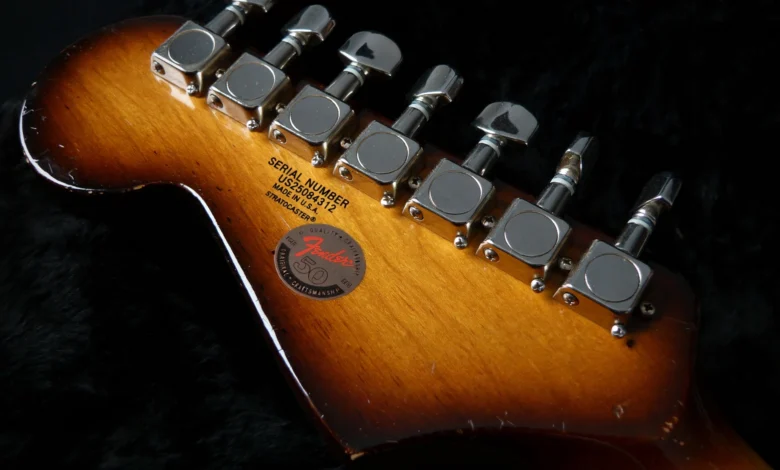
The serial number on a Fender is not always in the same place, and where you find it is itself a clue to the age of the instrument, because Fender moved the number three times over the course of its history. On the very earliest instruments, from 1950 to 1954, the serial number was stamped into the bridge plate, which is the metal plate where the strings anchor on a Telecaster, Esquire, or Precision Bass, and on the first Stratocasters it was placed on the tremolo spring cover on the back of the body. From the middle of 1954 until 1976, the serial number moved to the neck plate, which is the chrome plate on the back of the body where the neck bolts on, and that remained the standard location for more than twenty years. From 1976 onwards, Fender moved the number to the headstock, first on the front as part of the decal until around 1995, and then on the back of the headstock, which is where you will find it on most modern instruments, often with the words “Made in USA” or the country of manufacture printed nearby.
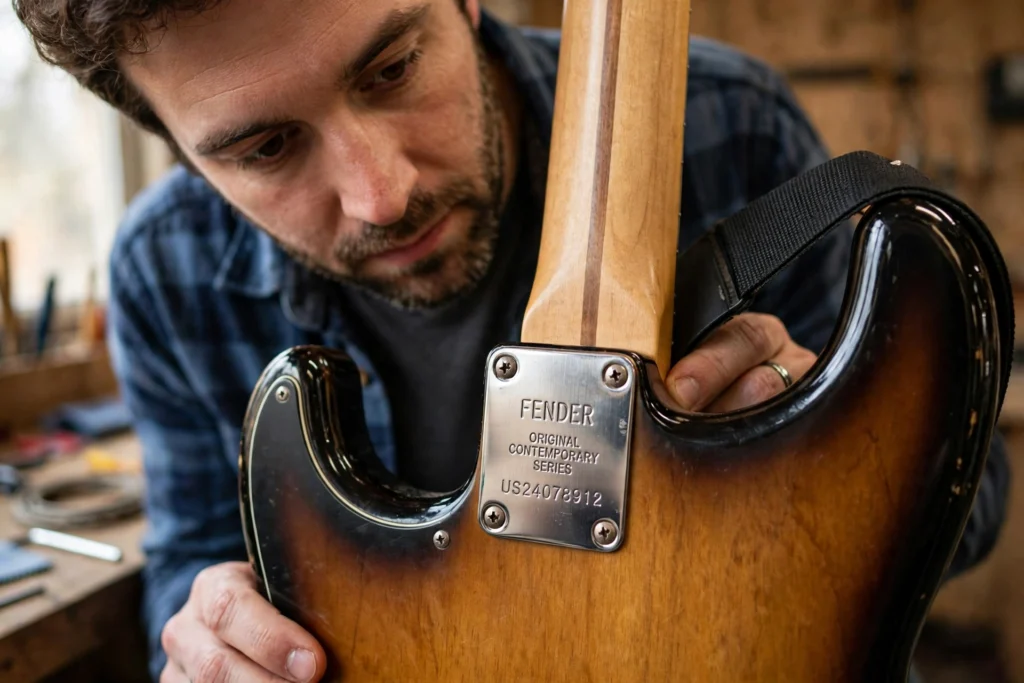
When you go looking for the number, start by turning the guitar over and checking the back of the headstock, because that is where it lives on almost every Fender made in the last thirty years, and it is usually printed clearly in black or silver. If it is not there, check the neck plate on the back of the body, and if your guitar is a very early model, look at the bridge plate or the tremolo cover instead. On Japanese-made Fenders, the serial number can also be found on the back of the neck heel, which means you need to remove the neck to see it, and that is a job for a guitar technician rather than something to attempt at home without experience. Write the number down exactly as it appears, including every letter and digit, and take a clear photograph of it, because a single letter makes the difference between a 1978 guitar and a 1988 guitar, and a mistake at this stage will send the whole lookup in the wrong direction.
How to Use Fender’s Official Serial Number Lookup Tool
Fender’s official serial number lookup tool is a free search page on Fender’s own website, and it is the best starting point for any fender serial number lookup, because it draws directly on Fender’s own production records rather than on a third-party guess. To use it, go to the official lookup page at serialnumberlookup.fender.com, type your serial number into the search box exactly as it appears on the guitar, and press search, and the tool will return the information it holds for that number, which usually includes the model name, the production year, and the country where the instrument was made. The whole process takes seconds, and you do not need to create an account or pay anything, which makes it the easiest check you can do before you spend money on a guitar or list one for sale.
It is important to know what the tool does well and where it falls short, because expecting it to answer every question will only lead to frustration. The tool works best for modern instruments, roughly from 1990 to the present day, and it returns a model name and an approximate year for most of them, but it has significant gaps for anything made before 1976, and it does not cover every model, every short production run, or every Custom Shop instrument. If the tool returns a result, treat it as a strong starting point and then cross-check it against the other clues on the guitar, and if it returns nothing, do not assume the guitar is fake, because a blank result often means the records for that era are incomplete rather than that the instrument is not genuine. Fender itself says that dating by serial number is not always precisely definitive, so the official tool is the beginning of the answer, not the end of it.
How to Read Fender Serial Numbers by Era
Fender changed its serial number system several times, and the way to read a number depends on which era it comes from, so the first step is to work out which system you are looking at before you try to decode it. For instruments made from 1976 onwards, Fender used a letter to show the decade, with S meaning the 1970s, E meaning the 1980s, N meaning the 1990s, and Z meaning the 2000s, and the first digit after the letter gives the year within that decade, so a serial starting with N9 would point to the late 1990s, while a serial starting with Z5 would point to the mid-2000s. This system is simple once you know it, but it is not exact, because Fender’s numbering often overlapped two to four years, and Fender’s own published guidance says that serial numbers were sometimes used out of order, so the letter and digit give you a range rather than a single certain year.
Modern American instruments use a clearer system, because since March 2010 most instruments made in the United States carry a serial starting with US followed by eight digits, and the first two digits are the year, so US10 means 2010 and US24 means 2024, with the remaining digits carrying no dating information. Mexican-made Fenders use prefixes such as MN, MZ, and MX, with the letter and the first digit again pointing to the decade and year, while Japanese-made Fenders from the early 1980s use the JV prefix for instruments made from 1982 to 1984, and the SQ prefix for Japanese Squiers from 1983 to 1984. Older instruments use plain numbers on the neck plate, with four or five digits for the 1950s and early 1960s, an L prefix for 1963 to 1965, and a large F logo with a six-digit number for the CBS era from late 1965 to 1976, but those ranges overlap and were sometimes reused, so they should be treated as a guide rather than a precise date. Where a serial range is uncertain, this guide says so rather than inventing a precise year, and the honest answer for many vintage instruments is a range of two or three years rather than a single date.
What to Do When the Official Lookup Finds Nothing
When the official lookup finds nothing, the first thing to do is to check that you typed the number correctly, because the most common reason for a blank result is a simple mistake, such as confusing a zero with the letter O, or missing a letter at the start of the number. Read the number again from the guitar itself rather than from your notes, take a photograph and zoom in on it, and try the search again, and if the number contains a prefix such as US, MN, or JV, make sure you have included it, because the tool needs the full number to find a match. If the search still returns nothing, try searching without any spaces, and if your guitar is a Squier rather than a Fender, remember that Squier has its own serial systems, so a Fender lookup may not cover it at all.
If the number is correct and the tool still has no record, the next step is to date the guitar from its other features, because the serial number is only one of several dates hidden in the instrument. The strongest of these is the date written or stamped on the neck heel, which is visible only when the neck is removed, and most Fenders from the 1950s to the 1980s have a pencil or ink date there, often with a matching date in the body’s neck pocket, and that date usually outranks the serial number when the two disagree. The potentiometer codes inside the control cavity are another useful check, because the volume and tone pots carry a code that shows when the pot was made, for example a code starting with 137 followed by the year and week, and while a pot code only proves when the pot was made, a pot dated after the neck date is a warning sign. For Custom Shop instruments, the certificate of authenticity is the reliable source, and for any instrument where the value is high, Fender’s Consumer Relations team can help if you contact them with the serial number in hand.
How to Check Your Fender Is Genuine Before You Buy or Sell
Checking that a Fender is genuine starts with the serial number, but it does not end there, because a serial number on its own can be copied, and a real check means comparing the number with everything else on the guitar. Start by confirming that the serial number matches the model the seller claims it is, because a number that belongs to a Mexican-made instrument on a guitar being sold as American-made is a clear warning sign, and then check that the number sits in the right place for its era, because a headstock serial on a guitar that claims to be from 1962, when serials lived on the neck plate, does not add up. Look at the logo, the hardware, the finish, and the case, and ask yourself whether they all belong to the same period, because a guitar with a 1970s neck, a 1990s body, and a modern bridge is a parts guitar, even if every part is a genuine Fender part, and it is worth far less than an all-original instrument.
The practical checks that matter most are the ones you can do in a few minutes with the guitar in your hands, and they are worth doing even when the seller seems trustworthy. Play the guitar and listen for anything odd, check that the neck is straight and the frets are even, look inside the control cavity for signs of replaced wiring or solder, and check that the neck heel date, the pot codes, and the serial number all fall within a few months of each other, because on a genuine, unmodified guitar they usually do. If you are spending serious money, consider paying a reputable guitar technician or dealer to inspect the instrument, because an expert can spot a refinished body, a replaced neck, or a fake decal in minutes, and that inspection costs far less than the price of a mistake. Take photographs of the serial number, the neck heel, and the headstock before you buy, and keep them with your receipt, because they are your evidence if anything turns out to be wrong later.
Common Mistakes When Dating a Fender
The most common mistake when dating a Fender is treating the serial number as a precise date, when Fender’s own guidance says that serial numbering was often non-sequential and usually overlapped two to four years, so a serial number alone can only ever give you a range. Many owners look up a number, see a single year, and then state that year as a fact when they sell the guitar, and that is how incorrect dates spread from one listing to the next, so the honest approach is to give the range and explain how you narrowed it. Another common mistake is using a chart for the wrong country, because Fender ran parallel numbering systems in the United States, Mexico, Japan, Korea, and Indonesia, and a prefix that means one thing in one system can mean something entirely different in another, so always work out which factory made your guitar before you try to read its number.
A third mistake is ignoring the reissue problem, because Fender has made many reissue guitars that deliberately copy vintage serial number formats, and a V-prefix serial is a good example, since older V serials from 1982 to 2012 encode no date at all and can only be dated from the neck heel, while the American Vintage relaunch from the middle of 2012 used V followed by seven digits, with the first two digits giving the year. A fourth mistake is trusting a single online decoder without checking it against the official tool and the physical dates on the guitar, because third-party decoders vary in quality and some are out of date, and a fifth mistake is removing the neck yourself to check the heel date without knowing how to do it safely, which can damage the guitar, so leave that job to a technician. The rule that ties all of this together is simple: use the serial number to narrow the range, use the neck date and pot codes to confirm it, and never claim more precision than the evidence supports.
Conclusion
A fender serial number lookup is the quickest route to dating your guitar, and for most modern instruments it is all you need, because Fender’s official tool will return the model, the year, and the country of manufacture in a matter of seconds. For older instruments, the lookup is the starting point rather than the final answer, and the real skill is in combining the serial number with the neck heel date, the pot codes, and the hardware to build a picture that all the evidence supports. Remember the key facts: the number lives on the bridge plate for the earliest guitars, on the neck plate from the middle of 1954 to 1976, and on the headstock from 1976 onwards, and the decade letters S, E, N, and Z, along with the modern US system, are the codes that unlock most numbers from the last fifty years.
The habit that protects you, whether you are buying, selling, or simply curious, is to treat the serial number as a clue rather than a verdict, and to check it against at least one other date on the guitar before you state a year with confidence. Write the number down exactly, run it through the official tool, and then look at the neck date and the pot codes, and if they all agree within a few months, you have a date you can trust. If they disagree, take the guitar to an expert before you spend money or set a price, because a careful check now is worth far more than a costly correction later, and the guitar you end up with will be one whose story you actually know.
How do I do a fender serial number lookup?
You do a fender serial number lookup by finding the serial number on your guitar, which is usually on the back of the headstock on modern instruments, on the neck plate for guitars made from the middle of 1954 to 1976, or on the bridge plate for the earliest models, and then typing it into Fender’s official lookup tool at serialnumberlookup.fender.com. The tool will return the model name, the production year, and the country of manufacture for most instruments, and it is most reliable for guitars made from around 1990 onwards. Write the number down exactly, including every letter, and take a photograph of it before you search.
Where is the serial number on a Fender Stratocaster?
The serial number on a Fender Stratocaster is on the back of the headstock on almost every modern instrument, and that is the first place to look, because Fender moved the number there from 1976 onwards, first on the front of the headstock until around 1995 and then on the back. On a Stratocaster made from the middle of 1954 to 1976, the number is on the neck plate on the back of the body, and on the very first Stratocasters from 1954, it was placed on the tremolo spring cover on the back of the body. Japanese-made Stratocasters may also carry the number on the back of the neck heel, which is only visible when the neck is removed.
What does the serial number tell me about my Fender?
The serial number tells you which numbering system your Fender belongs to, and from that system you can usually work out the approximate year of production and the country where the instrument was made, and the official lookup tool will often give you the model name as well. For modern American instruments, a serial starting with US followed by eight digits gives the year directly in the first two digits, while for instruments from 1976 onwards, a letter such as S, E, N, or Z shows the decade. The number does not tell you everything on its own, because Fender’s numbering often overlapped two to four years, so it should be cross-checked against the neck heel date and the pot codes for a firm answer.
Why does Fender’s official lookup find nothing for my guitar?
Fender’s official lookup may find nothing for your guitar because the tool has significant gaps for instruments made before 1976, and it does not cover every model, every short production run, or every Custom Shop instrument, so a blank result does not mean the guitar is fake. The most common cause is a typing mistake, so check the number again from the guitar itself and make sure you have included any prefix such as US, MN, or JV, and remember that Squier instruments have their own serial systems that the Fender tool may not cover. If the number is correct and the tool still has no record, date the guitar from its neck heel stamp and pot codes instead.
Can I date my Fender from the serial number alone?
You can narrow down the date of your Fender from the serial number alone, but you should not treat it as a precise date, because Fender’s own guidance says that serial numbering was often non-sequential and usually overlapped two to four years, so the number gives you a range rather than a single certain year. For a firm date, cross-check the serial number against the date on the neck heel, which is the strongest evidence on most guitars from the 1950s to the 1980s, and against the potentiometer codes inside the control cavity, which show when the pots were made. If all of those dates fall within a few months of each other, you can be confident in the result.