Camping Electric Hook Up: The Practical Camper’s Guide to EHU in the UK
A camping electric hook up, usually called EHU, is a mains electricity supply on a campsite pitch that lets you plug your tent, campervan or caravan into the site’s power network, just as you would plug an appliance into a socket at home. Instead of relying on a leisure battery or a gas stove for everything, you connect a special outdoor cable from a hook-up bollard on your pitch to your unit, and that gives you 230-volt mains power for lights, charging phones, running a small fridge or boiling a kettle. As of November 2026, almost every established touring site in the UK offers electric pitches, and for many campers the hook-up has become the difference between roughing it and enjoying a comfortable night under canvas.
What Is an Electric Hook Up?
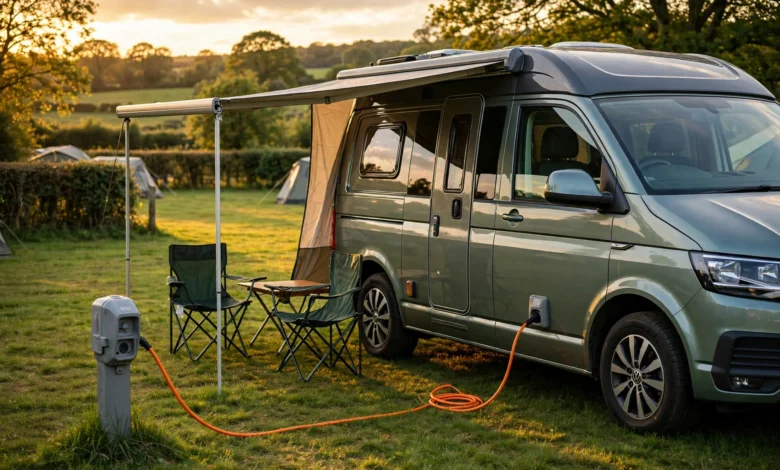
An electric hook up is simply a weatherproof power point provided on your pitch, and understanding what it is will take the mystery out of your first EHU trip. The hook-up point is usually a grey or green bollard, a short post with one or more sockets under a hinged cover, and it stands at the edge of the pitch so that your cable can reach it without trailing across a walkway. Inside your tent or caravan, the cable connects to a mains inlet socket, and from there the power runs to your internal sockets, lights and appliances, either directly or through a small consumer unit with its own circuit breakers.
Most UK campsites supply EHU at 16 amps, which is the standard for touring pitches, and that figure is the key to everything else you need to know. Sixteen amps at 230 volts gives you roughly 3,680 watts of power to play with, which sounds generous until you realise that a single electric kettle can draw 2,000 watts on its own, so you cannot run every appliance at once. Some smaller or older sites still offer 10-amp hook-ups, and a few European sites supply as little as 6 amps, so it is always worth checking the amperage when you book, because it decides what you can realistically run at the same time.
How Does an Electric Hook Up Work on Site?
A camping electric hook up works in a straightforward way once you have done it for the first time, and the routine quickly becomes second nature. When you arrive at your pitch, you will find the hook-up bollard nearby, and your first job is to uncoil your EHU cable fully, because a coiled cable can overheat when it carries a heavy load, and then plug one end into the bollard and the other end into the mains inlet on your tent, campervan or caravan. Most bollards have a small switch or a residual current device, known as an RCD, and you should switch the power on at the bollard, check that the RCD is set, and then switch on your appliances one at a time inside your unit.
The site’s electrical system protects you in two ways, and both are worth understanding before you plug anything in. The RCD on the bollard or in your unit will cut the power in a fraction of a second if it detects a fault, such as electricity leaking through water or a damaged cable, while the miniature circuit breaker will trip if you try to draw more current than the pitch allows. If the power trips, do not simply switch it straight back on and carry on as before: unplug something, work out what caused the overload, and only then reset the breaker. Many experienced campers keep a small torch in the car for this exact moment, because a tripped hook-up on a dark campsite is much easier to fix when you can see what you are doing.
What Cable and Equipment Do You Need for EHU?
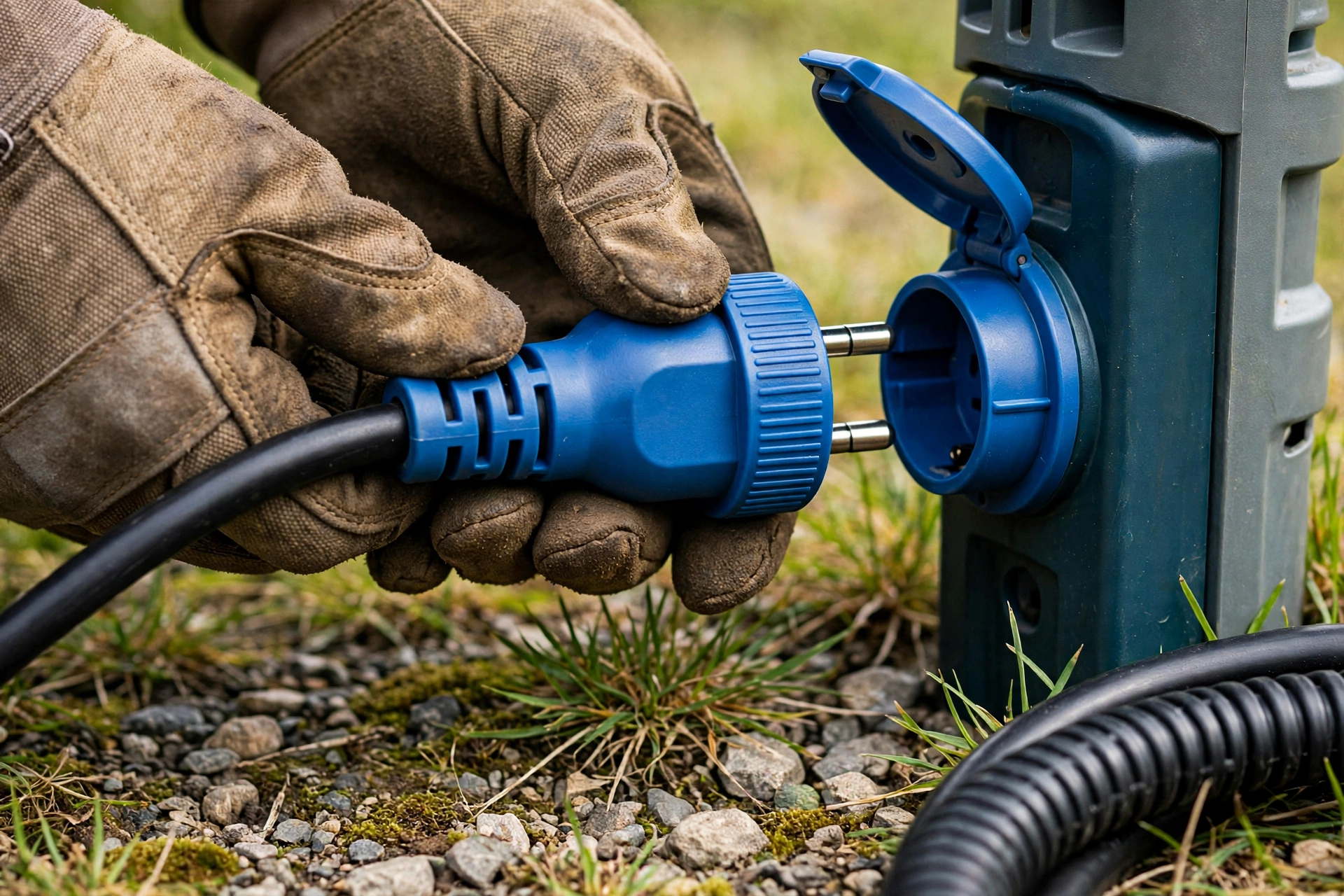
The one piece of equipment you cannot do without for an electric hook up is the EHU cable itself, and buying the right one will save you frustration on your first trip. The standard UK hook-up cable is an orange or blue 25-metre lead with a three-pin 16-amp plug on one end and a matching socket on the other, and it is designed for outdoor use with thick insulation that can cope with rain, mud and being driven over. You should always uncoil it completely before use, keep the connections off the ground where possible so they stay dry, and never join two cables together with an ordinary domestic extension lead, because household leads are not rated for outdoor use and can be dangerous in wet conditions.
Beyond the cable itself, a few small extras make EHU camping much easier, and most of them cost less than a night on a pitch. A cable tidy or a simple hook keeps the lead off the grass and stops fellow campers from tripping over it, while a short three-pin adaptor lets you plug ordinary household appliances into the internal sockets of a tent that has a mains inlet. If you are camping in a tent rather than a caravan, you will also need a mains inlet unit that sits in the tent doorway or a purpose-made electric hook-up unit with built-in sockets and USB charging points, and these are widely available from camping shops. It is also sensible to carry a spare fuse or two and a small plug-in socket tester, which confirms in seconds that the bollard is wired correctly before you connect your expensive appliances.
What Can You Run on Your Hook Up?
What you can run on your hook up depends on the amperage of your pitch and on how much power each appliance draws, and a little simple arithmetic will keep you comfortably within the limit. On a standard 16-amp pitch you have about 3,680 watts available, which is enough for a small fridge, LED lighting, phone charging and a low-wattage kettle, but not enough to run a kettle, a fan heater and a hairdryer all at the same time. A typical camping fridge draws only 60 to 100 watts, a phone charger draws less than 20 watts, and LED lights draw almost nothing, so the everyday essentials are easy, while the big power users are anything that makes heat.
Kettles, fan heaters, hairdryers and electric hotplates are the appliances that trip hook-ups most often, because each one can draw 1,000 to 2,000 watts on its own, and two of them together will exceed a 16-amp supply in seconds. The practical answer is to use low-wattage camping versions of these appliances, which are designed to draw 800 watts or less, and to run only one heating appliance at a time. Many campers boil the kettle first, switch it off, and only then switch on the heater, and that simple habit prevents almost every tripped breaker. If you are unsure what an appliance draws, check the label on its plug or its base, where the wattage is printed, and add up the watts of everything you plan to run together before you switch them on.
How Do You Use Your Hook Up Safely?
Using your hook up safely is mostly a matter of common sense, but a few specific rules are worth learning because electricity and wet grass are a combination that demands respect. Always uncoil your cable fully before you plug it in, because a tightly coiled cable carrying a heavy load can build up heat and melt its own insulation, and always keep the plug and socket connections raised off the ground and sheltered from rain where you can. Never use a damaged cable, a plug with a cracked case, or an ordinary indoor extension lead outdoors, and if you notice any scorching, fraying or damp inside a connector, stop using it and replace it before your next trip.
Water is the other thing to think about, because campsites are wet places and rain can arrive without warning in the British summer. Make sure the bollard cover closes properly over your plug, keep the cable run away from puddles and tent guy ropes where people might trip, and never handle the plugs with wet hands. The RCD is your safety net, and you should test it by pressing the test button when you first connect, because a working RCD will cut the power instantly and prove that the protection is live. If the RCD will not reset, or if it trips repeatedly for no clear reason, report it to the site warden rather than trying to bypass it, because a faulty RCD is a sign that something is wrong and the warden would much rather fix it than deal with an accident.
How Much Does an Electric Hook Up Cost?
An electric hook up usually adds a few pounds per night to the price of a pitch, and the exact amount varies from one site to another across the UK. As of November 2026, most touring sites charge between £4 and £8 per night for an electric pitch on top of the basic pitch fee, although some sites include electricity in a single all-in price and others charge a flat rate for the whole stay. Larger holiday parks and premium sites can charge more, particularly in peak season, while small farm sites and Certified Locations may charge less, and organisations such as The Camping and Caravanning Club list many sites where you can compare pitch prices and facilities before you book.
The cost is usually good value when you work out what you get for it, because a hook-up lets you run a fridge, charge devices, light your tent and boil a kettle without buying gas, ice or disposable batteries. A family that would otherwise spend several pounds a day on ice for a cool box and on charging devices at a cafe will often find that the hook-up pays for itself before lunch. Some sites meter their electricity and charge for the units you actually use, which is fairer for light users, while most simply charge a flat nightly rate regardless of how much power you draw, so the heavy user and the light user pay the same. When you book, ask whether the hook-up is included, what the amperage is, and whether there is a limit on the number of appliances, because those three answers will tell you everything you need to plan your packing.
Do You Need an Electric Hook Up for Your Camping Trip?
Whether you need an electric hook up for your camping trip depends on how you like to camp, how long you are staying, and what you cannot live without for a few days. If you are camping for a single night in summer with a gas stove and a torch, you probably do not need one, and a non-electric grass pitch will be cheaper and often quieter. If you are staying for a week with children, a fridge full of food, phones and tablets to charge, and a desire for a warm light in the evening, then a hook-up transforms the trip from an exercise in endurance into a genuinely comfortable holiday.
The honest answer for most first-time campers is to book an electric pitch for your first trip, because it removes a whole set of worries and lets you concentrate on enjoying the campsite rather than rationing battery power. You can always try a non-electric pitch on a later trip once you know what you actually use, and many experienced campers alternate between the two depending on the season and the site. If you want help choosing a site, The Caravan and Motorhome Club lists UK campsites with electric pitches and lets you filter by the facilities that matter to your family. A hook-up is also worth booking if anyone in your party uses medical equipment that needs mains power, such as a CPAP machine, because that is a genuine need rather than a luxury, and you should tell the site when you book so they can put you on a reliable pitch. Whatever you decide, the choice is yours, and the best pitch is the one that matches the way your family actually camps.
Conclusion
An electric hook up is one of the simplest upgrades you can make to a camping trip, and once you have used one, it is hard to imagine going back to a cold tent and a dead phone. The hook-up gives you mains power on your pitch for lights, charging, refrigeration and a hot drink, and all it asks in return is a proper outdoor cable, a little care with the load, and a few basic safety habits. Uncoil the cable fully, respect the 16-amp limit, run only one heating appliance at a time, test the RCD, and keep the connections dry, and the system will look after you for the whole stay.
If you are booking your first electric pitch, choose a site that tells you the amperage upfront, pack a low-wattage kettle, and add up the watts before you switch everything on. That small amount of preparation is the difference between a relaxing evening under the awning and a dark tent with a tripped breaker. An electric hook up does not take the adventure out of camping; it simply takes the cold, the dark and the flat batteries out of it, and that leaves more of your energy for the parts of camping that actually matter. If you are still building your camping kit, our guide to camping shops in Poole is a useful place to start for gear, accessories and outdoor essentials.
FAQs
What is a camping electric hook up?
An electric hook up, or EHU, is a mains electricity supply on a campsite pitch that lets you plug your tent, campervan or caravan into the site’s power network. You connect a special outdoor cable from a hook-up bollard on your pitch to your unit, and that gives you 230-volt mains power for lights, phone charging, a small fridge or a kettle. Most UK sites supply EHU at 16 amps as of November 2026. Once you have used a hook-up for the first time, the routine becomes second nature, and most campers say they would not go back to camping without one on a longer stay.
What cable do I need for a camping electric hook up?
You need a standard UK EHU cable, which is a 25-metre outdoor-rated lead with a three-pin 16-amp plug on one end and a matching socket on the other. The cable is usually orange or blue and has thick insulation for outdoor use. Always uncoil it fully before use, never join it to an ordinary indoor extension lead, and replace it if the plug or insulation is damaged. If your cable is damaged or too short for the pitch, do not improvise with a household lead; buy or borrow a proper outdoor-rated cable before you connect anything to the bollard.
How many amps is a camping electric hook up in the UK?
Most UK campsites supply a camping electric hook up at 16 amps, which gives you roughly 3,680 watts of power at 230 volts. Some smaller or older sites still offer 10-amp hook-ups, and some European sites supply as little as 6 amps, so it is always worth checking the amperage when you book, because it decides what you can run at the same time. If you arrive at a site and discover the supply is only 10 amps, you can still camp comfortably, but you will need to be more careful about running heating appliances one at a time.
Can I run a kettle on a camping electric hook up?
Yes, you can run a kettle on an electric hook up, but you should use a low-wattage camping kettle and run it on its own. A standard household kettle can draw 2,000 watts, which is more than half of a 16-amp supply, so running it at the same time as a fan heater or hairdryer will trip the breaker. Boil the kettle first, switch it off, and only then switch on your next appliance. A low-wattage camping kettle that draws 800 watts or less is a worthwhile investment, because it leaves you enough power for lights, charging and a small fridge at the same time.
Is a camping electric hook up safe in the rain?
Yes, a camping electric hook up is designed to be safe in the rain when it is used correctly, because the bollard and the connectors are weatherproof and the circuit is protected by an RCD that cuts the power instantly if it detects a fault. Keep the connections raised off the ground, make sure the bollard cover closes over the plug, never handle plugs with wet hands, and test the RCD when you first connect. If the RCD trips repeatedly or will not reset, report it to the site warden rather than trying to bypass it, because a faulty safety device is a sign that something needs attention.