Amber Reflective Studs on Motorway: A Driver’s Guide to Reading the Road at Night

Amber Reflective Studs on Motorway: A Driver’s Guide to Reading the Road at Night
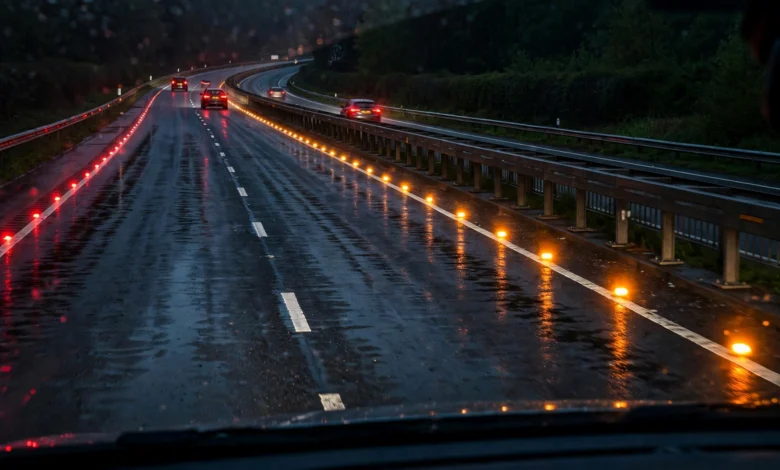
Amber reflective studs on a motorway mark the central reservation, which is the barrier in the middle of the road that separates traffic going in opposite directions. When you are driving at night and you see a line of small amber lights glowing along the right-hand edge of the carriageway, you are looking at the boundary between your side of the motorway and the oncoming traffic, and that line of light is one of the most important pieces of information the road gives you after dark. As of November 2026, this colour code has not changed for decades, and it remains part of the official Highway Code that every UK driver is expected to know, whether they are sitting a theory test or driving home on a wet November evening.


What Are Amber Reflective Studs?
Amber reflective studs are small raised markers set into the surface of the road, and each one contains a reflective lens that bounces your headlights back towards your eyes so that the stud appears to glow in the dark. They are sometimes called cats’ eyes, after the original design invented in the 1930s, although modern motorway studs are usually flat or slightly domed plastic or metal units rather than the glass domes of the past. On a motorway, the amber studs run in a continuous line along the right-hand edge of the carriageway, next to the central reservation, and they give you a clear visual guide to where the road ends and the barrier begins.
The reason the studs glow amber rather than white or red is that the colour itself carries a meaning, and the Highway Code uses four colours to mark four different parts of the road. Amber means the central reservation, red means the left-hand edge of the carriageway, white means the lane markings between lanes, and green means a slip road or a lay-by. Learning those four colours is one of the simplest ways to read a motorway at night, because the studs tell you where you are even when the painted lines are worn, the rain is heavy, or the street lighting has ended. If you can remember that amber always sits on your right on a motorway, you will never be confused about which side of the road you are on, even on a dark and unfamiliar stretch.
What Do Amber Studs Mark on the Motorway?
Amber studs mark the central reservation on a motorway, and that is the answer the driving theory test expects you to give when it asks what amber reflective studs mean. The central reservation is the strip of land or the concrete barrier that runs down the middle of a motorway and keeps the two directions of traffic apart, and the amber line shows you exactly where your carriageway ends. If you are driving in the right-hand lane and the amber studs are close beside your car, you are near the barrier, while if they are far away to your right, you are in one of the left-hand lanes with plenty of room before you reach the reservation.
This matters most when visibility is poor, because a central reservation that you cannot see is a central reservation you might drift towards without realising it. In fog, heavy rain or darkness, the amber studs give you a constant reference point that does not depend on street lights, and they let you hold your lane with confidence instead of guessing where the edge of the road is. The official GOV.UK Highway Code sets out the stud colours in Rule 132, and it is worth reading that rule alongside the other road marking rules, because the studs and the painted lines work together to tell you the same story about the road ahead. As of November 2026, Rule 132 remains the authoritative source for this information, and it is the rule the theory test draws on.
What Do the Other Reflective Stud Colours Mean?
The other reflective stud colours each mark a different part of the road, and learning all four together is easier than learning amber on its own. Red studs mark the left-hand edge of the carriageway, so when you see a line of red studs on your left, you know that beyond them lies the hard shoulder or the verge, and that you should not cross them in normal driving. White studs mark the lane markings between the lanes of traffic, so they show you where one lane ends and the next begins, and they help you stay centred in your lane when the painted lines are hard to see.
Green studs mark slip roads, lay-bys and the entrances and exits of a motorway, so when you see a line of green studs, you know that a slip road or a stopping place is nearby and that you should be ready to slow down or to watch for joining traffic. The four colours work as a complete system: red on your left, white between your lanes, amber on your right beside the central reservation, and green where you can leave or join the motorway. A simple way to remember them is to think of a traffic light turned on its side, with red on the outside left, amber on the outside right, and green marking the way on and off the road.

What Should You Do When You Cannot See the Studs?
When you cannot see the studs, the first thing to do is to slow down, because the studs are your guide to the shape of the road, and driving fast without them is like driving with your eyes half closed. In thick fog, the reflective lenses may be too far away for your headlights to reach, or the road surface may be covered in water, snow or mud that hides them completely, and in those conditions your speed should drop to match what you can actually see. The Highway Code advises drivers to use dipped headlights in fog, to keep a greater distance from the vehicle in front, and to avoid overtaking unless it is clearly safe, and all of that advice becomes even more important when the studs have disappeared.
If the studs are missing because they have been worn away or damaged, you should rely on the painted lines, the road signs and the position of other traffic to guide you, and you should report the problem to the road authority if it is a serious hazard. Motorway maintenance teams replace worn studs regularly, but a single missing stud is rarely a danger on its own, because the line continues on either side of the gap and your brain fills in the missing piece without you noticing. The real danger is a long stretch where the studs have gone altogether, and that is when slowing down and increasing your following distance matters most. In roadworks, the stud colours may also change temporarily, because temporary markings and cones take over from the permanent studs, so stay alert for the signs and the cones rather than relying on the studs alone.
How Do Studs Help You in Fog and at Night?
Studs help you in fog and at night by giving your headlights something to bounce off, and that simple trick turns an invisible road edge into a visible line of light. Your headlights shine forward onto the road, and the reflective lens inside each stud sends that light straight back towards your eyes, which is why the studs seem to glow even though they produce no light of their own. The effect is strongest when your headlights are clean and correctly aimed, and it fades when the studs are dirty, damaged or covered in water, which is one more reason to keep your lights clean and to slow down when the road is wet.
In fog, the studs are most useful when they are close to your car, because fog scatters light and reduces the distance your headlights can reach, so a stud fifty metres ahead may be invisible while a stud ten metres ahead still glows clearly. That is why experienced drivers in fog watch the studs beside their own car rather than trying to see far ahead, and they use the rhythm of the studs passing by to judge their speed and their position in the lane. At night on a clear motorway, the studs work together with the painted lines to give you two independent guides to the shape of the road, and if one of them is hard to see, the other is usually there to help. The Driver and Vehicle Standards Agency sets the standards for road markings and studs, and its guidance underpins the theory test questions on this topic.
Why Do Some Studs Look Different Colours?
Some studs look different colours because the colour is built into the reflective lens, and each colour is deliberately chosen to match its position on the road. Amber studs look amber because their lens is amber, red studs look red because their lens is red, and so on, and there is no trick of the light involved: the colour you see is the colour the stud was made to show. If a stud looks a different colour from the ones around it, it may be damaged, dirty, or it may be a temporary stud laid down during roadworks, and in that case you should trust the majority of the studs and the road signs rather than a single odd one out.
You may also notice that some studs look brighter than others, and that is usually because they are newer, cleaner or angled slightly differently towards your headlights. A stud that has been driven over thousands of times will lose some of its reflectivity, and a stud that is covered in mud or spray will look dim until it is cleaned by rain or by a maintenance crew. Modern motorway studs are also made in different designs, including flat studs that sit flush with the road surface and slightly raised studs that are easier to see in wet conditions, but the colour code is the same whatever the design. If you are ever unsure what a stud means, the safest approach is to slow down, look for the road signs, and let the pattern of the studs around you tell you where you are.
What Is the Difference Between Studs and Road Markings?
The difference between studs and road markings is that studs are raised reflective markers set into the road surface, while road markings are painted lines and symbols laid flat on the surface, and the two work together to guide you. Painted lines are easy to see in daylight and in good weather, but they can disappear at night, in rain or when they are worn, while studs are designed to be visible in the dark because they reflect your headlights back at you. That is why a motorway has both: the paint tells you the rules in the daytime, and the studs keep telling you the same rules after dark.
Studs are also more durable than paint in some ways, because they sit in the road surface and are less affected by wear from tyres, although they can still be damaged by heavy traffic, snow ploughs and roadworks. The Highway Code treats the stud colours and the painted lines as parts of the same system, and the theory test may ask you about either one, so it is worth learning both together. When you see a white painted line between lanes, the white studs in the same place are confirming the same message, and when you see a solid white line at the edge of the carriageway, the red studs beside it are telling you the same thing in a different way. Together, they give you a belt-and-braces guide to the road that works in daylight and in darkness, in dry weather and in rain.
Conclusion
Amber reflective studs on a motorway mark the central reservation, and that single fact is the key to reading a motorway at night. When you see a line of amber lights glowing along the right-hand edge of the carriageway, you are looking at the boundary between your side of the road and the oncoming traffic, and that line tells you where the road ends and the barrier begins. The other colours complete the picture: red on your left for the edge of the carriageway, white between your lanes, and green where you can leave or join the motorway, and together they give you a simple, reliable guide that works in the dark, in the rain and in fog.
Learning the stud colours is one of the easiest wins in driving theory, because the answer never changes and the question comes up again and again in mock tests and in real driving. Remember that amber always sits on your right on a motorway, that it always means the central reservation, and that Rule 132 of the Highway Code is the official source for the whole colour code. The next time you drive at night, take a moment to notice the studs beside your car and to read the road the way they are showing it to you, because that habit will make you a safer driver long after your test is over. If you are planning a long motorway journey, it is also worth checking our live updates on M3 accident today live before you set off, so you know what to expect on the road ahead.
FAQs
What do amber reflective studs mean on a motorway?
Amber reflective studs on a motorway mark the central reservation, which is the barrier in the middle of the road that separates traffic travelling in opposite directions. The question ‘what do amber reflective studs mean on a motorway?’ is a standard UK driving theory test question, and the answer is always the central reservation. The amber studs run in a continuous line along the right-hand edge of the carriageway, next to the barrier, and they help you see where your side of the road ends at night, in fog and in rain. As of November 2026, this colour code is set out in Rule 132 of the Highway Code and has not changed.
What colour are the studs on the central reservation?
The studs on the central reservation are amber. On a motorway, the amber line always runs along the right-hand edge of the carriageway, beside the central reservation, and it is the colour that tells you the barrier is on your right. The other stud colours are red for the left-hand edge of the carriageway, white for the lane markings between lanes, and green for slip roads and lay-bys. If you can remember that amber means the central reservation, you will always know which side of the motorway you are on, even on a dark and unfamiliar stretch of road.
What do red reflective studs mean?
Red reflective studs mark the left-hand edge of the carriageway, so when you see a line of red studs on your left, you know that beyond them lies the hard shoulder or the verge. You should not cross a line of red studs in normal driving, because the hard shoulder is for emergencies only and is not a running lane. Red studs are the mirror image of amber studs: red on your left, amber on your right, and together they frame the carriageway and show you exactly how wide the road is.
What do white and green reflective studs mean?
White reflective studs mark the lane markings between the lanes of traffic, so they show you where one lane ends and the next begins and help you stay centred in your lane at night. Green reflective studs mark slip roads, lay-bys and the entrances and exits of a motorway, so when you see green studs, you know that a slip road or a stopping place is nearby. Together with red and amber, the white and green studs complete a four-colour system that lets you read the whole motorway by colour alone.
Why are some studs missing on the motorway?
Some studs are missing on the motorway because they have been worn away by heavy traffic, damaged by snow ploughs or roadworks, or removed during maintenance and not yet replaced. A single missing stud is rarely a danger, because the line continues on either side and your brain fills in the gap, but a long stretch with no studs at all is a sign that you should slow down and rely on the painted lines and road signs instead. Motorway maintenance teams replace worn studs regularly, and you can report a serious problem to the road authority if a long stretch has lost its studs altogether.