You Wish to Tow a Trailer. Where Would You Find the Maximum Noseweight for Your Vehicle’s Tow Hitch?

You Wish to Tow a Trailer. Where Would You Find the Maximum Noseweight for Your Vehicle’s Tow Hitch? — Theory Test Answer and Practical Guide
If you wish to tow a trailer, you would find the maximum noseweight for your vehicle’s tow hitch in the vehicle handbook. That is the correct answer to this UK driving theory test question, and it is the answer the Driver and Vehicle Standards Agency (DVSA) expects every learner driver to know before they sit the test. The handbook, which is also called the owner’s manual, lists the maximum downward force your car’s tow hitch can safely carry, and it is the single most reliable source for this figure because it comes directly from the vehicle manufacturer. You can also obtain the same information from your vehicle manufacturer’s agent if you have lost the handbook, but in the exam room there is only one right choice, and it is the vehicle handbook rather than The Highway Code, your licence documents or your vehicle registration certificate.


What Is the Answer to This Theory Test Question?
You wish to tow a trailer. Where would you find the maximum noseweight for your vehicle’s tow hitch? The answer is in the vehicle handbook, and understanding why the other three options are wrong will help you remember it long after your test is over. The Highway Code is a wonderful guide to the rules of the road, but it does not list the towing limits of your individual car, because those limits change from one model to another and even between different versions of the same model. Your licence documents prove that you are allowed to drive, and your vehicle registration certificate proves who owns the car, yet neither document carries any technical information about how much weight your tow hitch can bear.
The DVSA’s own explanation for this question is short and clear: you must know how to load your trailer or caravan so that the hitch exerts an appropriate downward force on the tow ball, and information about the maximum permitted noseweight can be found in your vehicle handbook or obtained from your vehicle manufacturer’s agent. If you are revising for the exam, the official GOV.UK driving theory test pages explain how the test works and what topics it covers. That wording is worth reading twice, because it tells you two things at once: the handbook is the primary source, and the manufacturer is the back-up source. In the theory test you will see this question in the vehicle loading section, and it usually appears alongside other questions about safe loading, tyre pressures and trailer stability, so revising the whole topic together makes each individual answer easier to recall.
What Exactly Is Noseweight and Why Does It Matter?
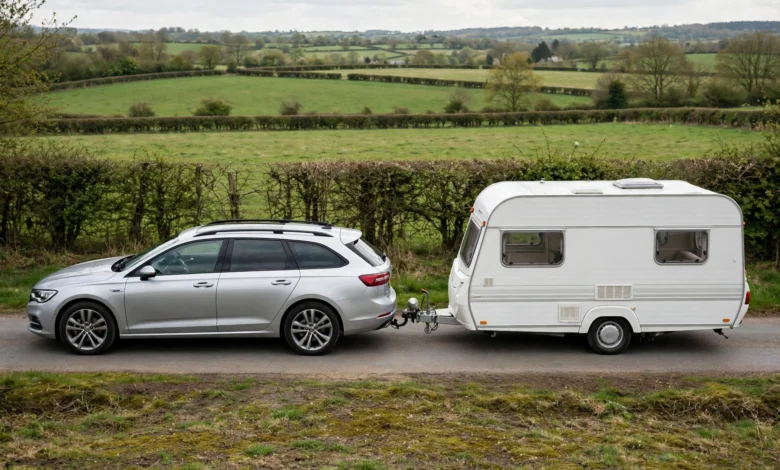
Noseweight is the downward force that a trailer or caravan exerts on your car’s tow ball, and it is measured in kilograms in the same way that you would weigh a heavy suitcase on a bathroom scale. When a trailer is hitched up correctly, its coupling presses down on the tow ball with a steady force, and that force is what keeps the trailer stable behind your car at motorway speeds. If the noseweight is too low, the trailer can start to sway from side to side, which is one of the most frightening experiences a driver can have, while if the noseweight is too high, the back of your car sags, your headlights point into the sky, your steering goes light and your braking distances grow longer.
For most family cars in the UK, the maximum noseweight sits somewhere between 45 and 75 kilograms, although larger cars and four-by-fours can allow 100 kilograms or more, which is why guessing is never a safe option and checking your own handbook matters so much. As a rough guide, experienced towers often aim for a noseweight of around 7 per cent of the trailer’s total loaded weight, but this is only a rule of thumb and it never overrides the maximum figure printed in your handbook. The maximum noseweight is a safety limit set by engineers who tested your car, so treating it as a suggestion rather than a limit puts you, your passengers and every other road user at risk.
How Do You Find the Maximum Noseweight in Your Vehicle Handbook?
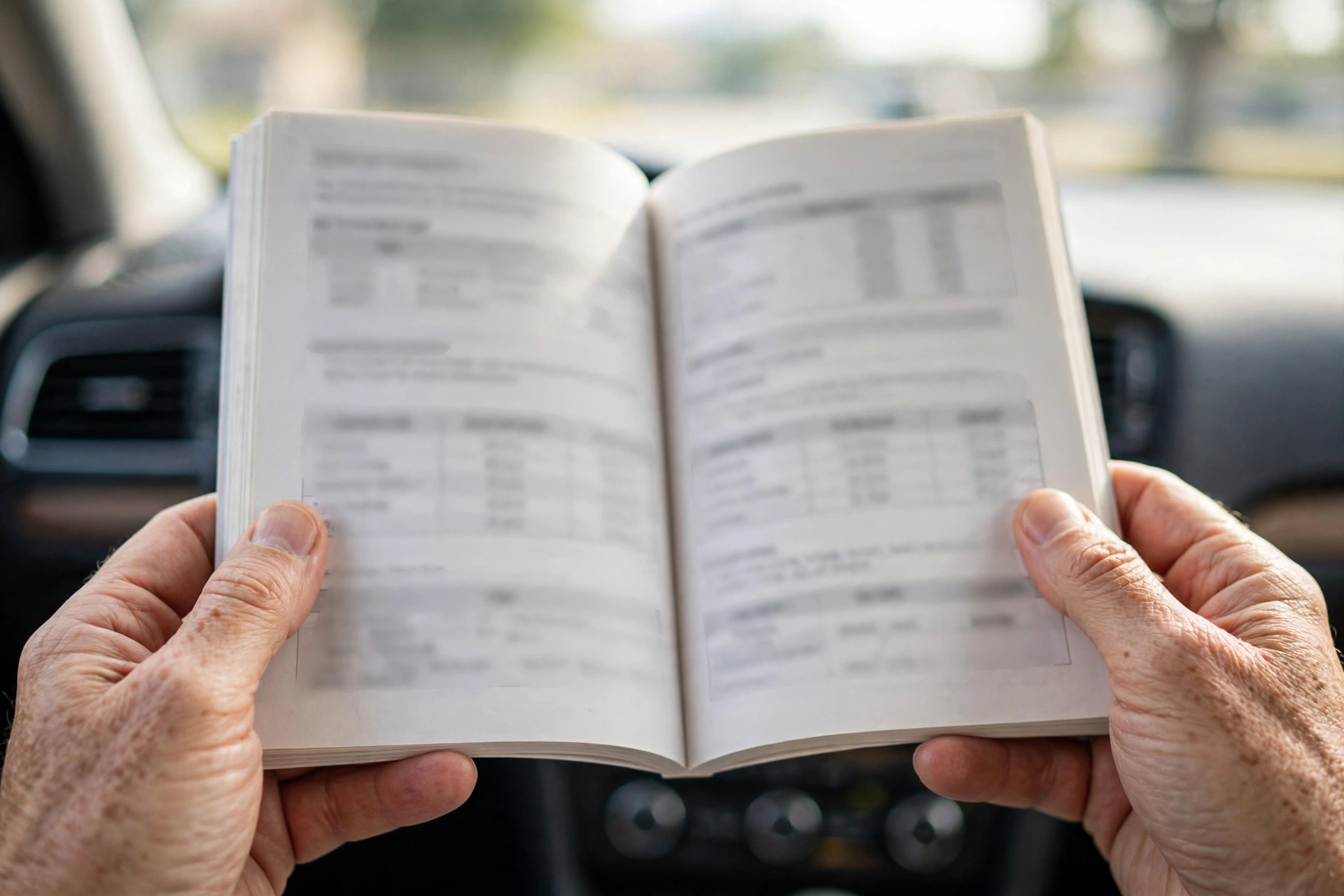
Finding the maximum noseweight in your vehicle handbook is easier than most drivers expect, because manufacturers almost always put it in the same two places: the towing section and the technical specifications at the back of the book. Open the index and look for the words towing, trailer, towbar or noseweight, and you will usually be taken straight to a page that lists the maximum braked towing weight, the maximum unbraked towing weight and the maximum noseweight side by side. If your handbook is a thick printed book, the technical data pages near the end are the fastest place to look, while if you have a digital handbook on your phone or on the manufacturer’s website, you can simply search the document for the word noseweight and jump straight to the answer.
It is worth checking the handbook for your exact model and engine, because the maximum noseweight can change between a petrol and a diesel version of the same car, or between a car with a factory-fitted towbar and one with an aftermarket towbar. If you bought your car second hand and the handbook is missing, you can usually download a free copy from the manufacturer’s website by entering your registration number or vehicle identification number, and your local dealer can also confirm the figure for you. Never rely on a figure you found on an internet forum for a different model year, because even a small difference in the limit can matter when you are towing a fully loaded caravan on a wet motorway.
What Other Places Show the Maximum Noseweight?
The vehicle handbook is the primary source, but it is not the only place where the maximum noseweight appears, and knowing the secondary sources will help you in real life even though the theory test only wants the handbook answer. If your car has an aftermarket towbar, the towbar itself usually carries a small metal plate or label that states its maximum vertical load, which is sometimes marked with the letter S, and that plate tells you the limit of the towbar rather than the limit of the car. The trailer or caravan also has its own handbook and its own data plate near the coupling, and that plate states the maximum noseweight the trailer is designed to exert, so you need to respect whichever limit is lowest.
The golden rule of towing is that when different sources give you different numbers, the smallest number always wins, because the weakest part of the whole outfit decides what is safe. GOV.UK’s guide to vehicle weights explained is a useful starting point if you want to understand how towing weights and limits fit together. If your car allows 75 kilograms but your towbar plate only allows 50 kilograms, then 50 kilograms is your real limit, and if your caravan’s coupling is rated to 60 kilograms while your car allows 75, then 60 kilograms is the figure you must not exceed. This lowest-limit rule is one of the most useful things you can learn as a tower, and it is exactly the kind of practical judgement that the theory test is trying to build, even though the exam question itself only asks where the figure is found.
How Do You Measure Noseweight Before You Set Off?
Measuring noseweight before you set off is a simple job that takes about five minutes, and it is the difference between guessing that your trailer is loaded safely and actually knowing that it is. The easiest tool is a dedicated noseweight gauge, which is a small spring scale that sits under the trailer coupling and shows the downward force in kilograms, and most caravan accessory shops sell one for the price of a family takeaway. You simply hitch the trailer, wind the jockey wheel down until the coupling rests on the gauge, read the number, and then adjust your loading until the reading sits safely below your handbook maximum.
If you do not own a gauge, you can use an ordinary bathroom scale with a short length of wood to spread the load, although you should take care to protect the scale and to keep the coupling at the same height it sits at when it is hitched to your car. The trick to adjusting noseweight is to move heavy items forwards or backwards inside the trailer: sliding a heavy box towards the front increases the noseweight, while moving it towards the back reduces it, and even small movements can change the reading by several kilograms. Always measure with the trailer loaded exactly as it will travel, including water, gas bottles and luggage, and re-check after you have packed everything, because a trailer that was perfectly balanced when empty can be badly out of balance once the family has loaded it for a fortnight’s holiday.
What Happens If You Exceed the Maximum Noseweight?
Exceeding the maximum noseweight is dangerous in ways that are not always obvious until something goes wrong, and the first sign is often that your car simply does not feel right on the road. Too much weight on the tow ball pushes the rear suspension down and lifts the front of the car, which makes the steering feel vague and light, reduces the grip of the front tyres, and throws your headlights up into the eyes of oncoming drivers at night. Your braking distances grow because the front brakes, which do most of the stopping work, have less weight pressing them onto the road, and the towbar itself can be damaged or even fail if it is overloaded again and again over many journeys.
Too little noseweight is just as dangerous in the opposite direction, because a trailer with almost no downward force on the tow ball is free to snake from side to side, and once a trailer starts snaking at speed it can quickly pull the whole car out of shape. That is why the handbook gives you a maximum rather than a target: you want a healthy downward force that is close to, but never above, the limit, and you want the load balanced so that the trailer follows your car in a straight, calm line. If you are stopped by the police or involved in an accident while towing with an overloaded hitch, you could also face prosecution for using a vehicle in a dangerous condition, and your insurance company may refuse a claim if the outfit was loaded beyond the manufacturer’s stated limits.
How Can You Remember This Question for Your Theory Test?
The best way to remember this question for your theory test is to link the answer to something you already understand, and the simplest link is that the handbook is the book that knows your car. The Highway Code knows the rules of the road, your licence knows who you are, and your registration certificate knows who owns the car, but only the handbook knows what your car can actually do, and that is why the maximum noseweight lives there. Many learners remember it with a short rhyme or a simple phrase, such as handbook holds the hitch limit, and repeating that phrase a few times while you revise is enough to make it stick.
Practise with the full question in the exact form the DVSA asks it, because the wording is always the same and familiarity breeds confidence on test day. When the question appears on screen — you wish to tow a trailer. where would you find the maximum noseweight for your vehicle’s tow hitch — the four options will be the vehicle handbook, The Highway Code, your vehicle registration certificate and your licence documents, and only the first of those is correct. When you sit a mock test, read all four options before you answer, and ask yourself which document would know the technical limits of your specific vehicle, because that question will always point you to the handbook. It also helps to revise this question together with the other vehicle loading questions, such as where to find the correct tyre pressures, because the handbook is the answer to several of them, and once you see the pattern, the whole topic becomes much easier. As of November 2026, this question remains part of the official DVSA car theory test, and the answer has not changed.
Conclusion
If you wish to tow a trailer, you would find the maximum noseweight for your vehicle’s tow hitch in the vehicle handbook, and that single fact is the key to both passing your theory test and towing safely in real life. The handbook gives you the manufacturer’s own limit for your exact model, the towbar plate and the trailer’s data plate give you the limits of the other parts of the outfit, and the lowest of all those numbers is the limit you must respect on every journey. Measuring the noseweight with a simple gauge before you set off turns a guess into a certainty, and keeping the load balanced protects your steering, your braking and your passengers.
Learning this question properly means learning more than an exam answer: it means understanding why noseweight matters, how to find it, how to measure it and what happens when it is wrong. So before your next towing trip, open the handbook, find the figure, check it against your towbar plate, and measure the real noseweight with the trailer fully loaded. That five-minute check is one of the most valuable habits any tower can build, and it starts with knowing exactly where to look. If you are planning your first caravan trip, it is also worth reading our guide to comparing caravan insurance quotes before you set off, because the right cover gives you peace of mind alongside a correctly loaded trailer.
FAQs
Where would you find the maximum noseweight for your vehicle’s tow hitch?
The question ‘you wish to tow a trailer. where would you find the maximum noseweight for your vehicle’s tow hitch?’ has one correct answer: you would find the maximum noseweight for your vehicle’s tow hitch in the vehicle handbook, which is also called the owner’s manual. The DVSA theory test expects this exact answer, and the official explanation adds that the information can also be obtained from your vehicle manufacturer’s agent. The handbook lists the limit for your exact model in the towing section or the technical specifications at the back, and for most UK family cars the figure falls between 45 and 75 kilograms as of November 2026.
What is noseweight in simple terms?
Noseweight is the downward force that a trailer or caravan pushes onto your car’s tow ball, measured in kilograms. It is the weight you would feel if you tried to lift the trailer’s coupling by hand when it is unhitched. A healthy noseweight keeps the trailer stable behind your car, while too much noseweight overloads the rear suspension and too little noseweight lets the trailer sway from side to side at speed. In practice, most drivers never need to lift a coupling by hand, because a noseweight gauge does the measuring for them, yet understanding the idea in plain terms makes it far easier to load a trailer correctly and to recognise when something feels wrong on the road.
Is the maximum noseweight in The Highway Code?
No, the maximum noseweight is not in The Highway Code, because The Highway Code sets out the rules of the road rather than the technical limits of individual vehicles. Your car’s maximum noseweight depends on its model, engine and towbar, so only the vehicle handbook or the manufacturer can give you the correct figure for your car. The Highway Code is still essential reading for towing, because it covers the rules on speed limits, mirrors and trailer lights. The theory test asks ‘you wish to tow a trailer. where would you find the maximum noseweight for your vehicle’s tow hitch?’ precisely because the answer separates drivers who know their car from drivers who are guessing, and the handbook is also the answer to several other vehicle loading questions, such as where to find the correct tyre pressures.
How do I measure noseweight at home?
You can measure noseweight at home with a dedicated noseweight gauge, which sits under the trailer coupling and shows the downward force in kilograms, or with a bathroom scale and a short piece of wood to spread the load. Always measure with the trailer loaded exactly as it will travel, with the coupling at the same height it sits at when hitched to your car, and adjust the load by moving heavy items forwards to increase the reading or backwards to reduce it.
What should I do if my car and towbar give different noseweight limits?
If your car and your towbar give different noseweight limits, you must use the lower of the two figures as your real limit. The same rule applies to the trailer’s own limit: whichever part of the outfit has the smallest maximum decides what is safe for the whole combination. Never exceed the lowest limit, because overloading any single part can damage it and make the outfit unstable on the road. This lowest-limit rule is one of the most useful things any tower can learn, and it applies every time you change cars, towbars or trailers, because the weakest part of the outfit always decides what is safe.