A pelican crossing is a pedestrian light-controlled crossing with a flashing amber phase, while a puffin crossing is a pedestrian user-friendly intelligent crossing with kerbside sensors and no flashing amber phase, and that single difference decides what you must do as a driver. At a pelican crossing, a flashing amber light means you must give way to anyone still on the crossing, but you may proceed with caution if the crossing is clear, whereas at a puffin crossing the lights follow the normal traffic light sequence, so you stop on red and go on green, with no flashing amber stage at all. The rules come from the Highway Code, with pelican crossings covered by Rules 196 to 198 and puffin crossings covered by Rule 199, and as of November 2026 those rules have not changed.


Most drivers can spot a zebra crossing from a long way off, because it has no traffic lights and its black and white stripes are unmistakable, but pelican and puffin crossings look almost identical from behind the wheel, since both have traffic lights, both have a push button, and both show a red man and a green man to pedestrians. The difference is hidden in the signal sequence and in the sensors, and that is exactly why the theory test asks about it so often, because a driver who cannot tell the two apart will not know whether a flashing amber light is coming or whether the lights will simply turn green. This pelican vs puffin crossing guide explains how to tell them apart in seconds, what each signal means, and what happens if you get it wrong.
What Is the Difference Between a Pelican and a Puffin Crossing?
The pelican vs puffin crossing difference starts with their names, because pelican is short for pedestrian light-controlled crossing, while puffin is short for pedestrian user-friendly intelligent crossing, and those two names describe two different generations of the same idea. A pelican crossing is the older design, and it shows the red man and green man signals on the far side of the road, across the street from the pedestrian, while a puffin crossing is the newer design, and it shows the red and green figures above the control box on the pedestrian’s own side of the road, at the kerb where they are waiting. That difference in signal position is the quickest way to tell them apart, because if the green man is across the road it is a pelican, and if it is beside you at the kerb it is a puffin.
The second difference is the sensors, because a puffin crossing has detectors that watch the crossing area and the kerb, and those sensors tell the signals whether pedestrians are still crossing, which means the red light for traffic can be held for longer when someone is slow, and the green man is only shown when it is safe to cross. A pelican crossing has no such sensors, and its timings are fixed, which is why it needs the flashing amber phase to bridge the gap between the pedestrian phase ending and the traffic phase beginning. The third difference is the signal sequence itself, and it is the one that matters most to drivers, because only the pelican has a flashing amber light, while the puffin follows the same red, amber and green sequence as an ordinary set of traffic lights, with no flashing stage at all.
How Does a Pelican Crossing Work for Drivers?
A pelican crossing works for drivers through a signal sequence that every learner must memorise, because the flashing amber phase is unique to this crossing type and it is the detail that the theory test asks about more than any other. When the lights turn red you must stop, and you must wait behind the stop line until the sequence moves on, just as you would at any traffic light, and the red man is showing to pedestrians at the same time so that nobody is crossing yet. The green man then appears for pedestrians, the traffic light stays red, and pedestrians cross while you wait, which is the straightforward part of the sequence that causes nobody any trouble.
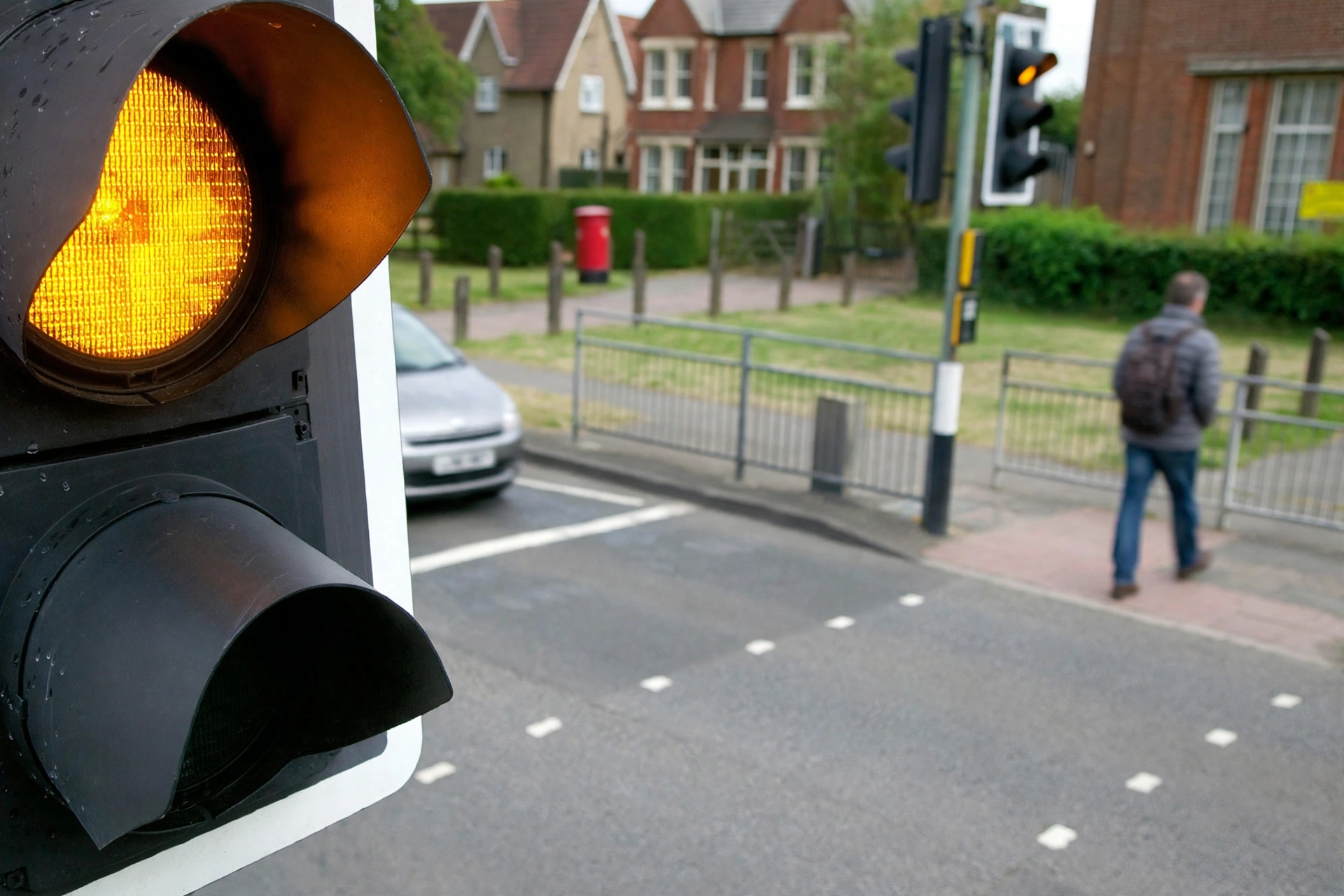
The tricky part comes next, because after the green man the pelican crossing shows a flashing green man to pedestrians and a flashing amber light to drivers, and that flashing amber is where the rule changes. When the amber light is flashing, you must give way to any pedestrians still on the crossing, but if the crossing is clear you may proceed with caution, and that is the only situation in British driving where a flashing amber light gives you permission to move rather than telling you to stop. If a pedestrian is still crossing, you must wait, and if the crossing is empty you may go, but you must be ready to stop again, because a pedestrian who started crossing late may still be on the road, and Rule 198 requires you to give way to anyone still crossing even after your signal has changed to green.
How Does a Puffin Crossing Work for Drivers?
A puffin crossing works for drivers in a simpler way than a pelican, because its lights follow the same sequence as an ordinary set of traffic lights, and there is no flashing amber phase to interpret, which removes the one judgement call that causes most confusion. When the lights turn red you must stop behind the stop line, and you must wait until the lights change, while the pedestrians see a red man on the signal box beside them at the kerb, which is the first visible difference from a pelican, since the pedestrian signals are on the near side rather than across the road. The sensors are already working at this point, because the kerbside detectors have registered that someone is waiting, and they will hold the red light for traffic for as long as the crossing is in use.
When the pedestrian phase begins, the green man appears on the near-side signal box, the traffic light stays red, and pedestrians cross while you wait, and the crossing area sensors watch them all the way across, extending the red phase if someone is slow, elderly or disabled and needs more time. When the last pedestrian has cleared the crossing, the signals change in the normal way, with a steady amber light followed by green, and you may proceed when the light is green and the crossing is clear, but you must still give way to anyone who is still crossing, because Rule 198 applies to every crossing type. The absence of a flashing amber phase makes the puffin easier to drive through correctly, and it is one of the reasons that new crossings are now usually built as puffins rather than pelicans.
What Happens at a Pelican vs Puffin Crossing When the Lights Change?
When the lights change at a pelican crossing, the sequence moves from red to flashing amber to green, and the flashing amber is the stage that demands a decision from the driver, because it is neither a stop signal nor a go signal, but a conditional permission that depends on what is happening on the crossing. If pedestrians are still on the road, you must wait, and the flashing amber does not override that duty, so a driver who accelerates through a flashing amber light while someone is still crossing commits an offence and risks a serious collision. If the crossing is clear, you may proceed with caution, which means moving off slowly, watching the kerbs for latecomers, and being ready to stop, because a pedestrian who hesitated at the kerb may step out at the last moment, and the flashing amber gives you no protection if you hit them.
When the lights change at a puffin crossing, the sequence is the familiar red, amber and green of an ordinary traffic light, and there is no decision to make, because a steady amber light means stop if you can do so safely, and a green light means go if the crossing is clear. The sensors make the change safer, because they extend the red phase while pedestrians are still on the crossing, so the lights will not turn green while someone is halfway across, and that removes the situation that the pelican’s flashing amber was designed to handle. If the signals are not working at either type of crossing, the Highway Code says to proceed with extreme caution, and at a puffin crossing Rule 199 adds that you must not enter the crossing if you cannot clear it completely, since blocking a crossing puts pedestrians in danger and can leave you stranded in the path of other traffic.
What Are the Penalties for Getting a Pelican or Puffin Crossing Wrong?
Getting a pelican or puffin crossing wrong can lead to a fine, penalty points, or a driving ban, depending on how serious the mistake was, and the most common offence is failing to stop at a red light, which carries a fixed penalty of three points and a one hundred pound fine, although the case can go to court and attract a larger fine if the circumstances are serious. Driving through a red light at a pedestrian crossing is treated as a serious matter by the courts, because it puts pedestrians at direct risk, and a driver who does so while someone is crossing can face a charge of careless or even dangerous driving, which carries much heavier penalties, including disqualification and, in the worst cases, a prison sentence.
The flashing amber phase at a pelican crossing creates its own trap, because a driver who proceeds while a pedestrian is still on the crossing has failed to give way, and that is an offence even though the light was amber rather than red, which surprises many drivers who assume that amber always means go. Failing to give way to a pedestrian on a crossing can also lead to penalty points and a fine, and it is one of the faults that can cause a learner to fail the practical driving test, since the examiner treats it as a serious fault. The safest approach is to treat every crossing as if a pedestrian might still be on it, to wait until the road is genuinely clear, and to remember that no journey is worth the risk of injuring someone who was crossing legally, because the penalties are the least of the consequences when a pedestrian is hurt.
Conclusion
In a pelican vs puffin crossing comparison, a pelican is a pedestrian light-controlled crossing with a flashing amber phase, while a puffin is a pedestrian user-friendly intelligent crossing with kerbside sensors and no flashing amber phase, and that single difference is the key to driving through both of them correctly. At a pelican, a flashing amber light means give way to anyone still crossing and proceed with caution if the crossing is clear, while at a puffin the lights follow the normal traffic light sequence, so you stop on red and go on green, with the sensors holding the red while pedestrians are still on the road. The rules are set out in the Highway Code, with pelican crossings covered by Rules 196 to 198 and puffin crossings covered by Rule 199, and as of November 2026 those rules have not changed.
The practical lesson is to slow down early whenever you approach a signal-controlled crossing, to look for the position of the pedestrian signals so that you know which type you are approaching, and to wait until the crossing is genuinely clear before you move off, whatever colour the light is showing. A pelican’s flashing amber is a permission, not an order, and a puffin’s green light is not a guarantee that the road is empty, so the driver’s judgement matters at both types, and the Highway Code backs that judgement with Rule 198, which requires you to give way to anyone still crossing after your signal has changed. If you want to understand more about the roads around you, our guide to with-flow bus lanes explains another road feature that the theory test loves to ask about, and together the two guides cover two of the most common sources of confusion for learners and experienced drivers alike.
What is the main difference between a pelican and a puffin crossing?
In a pelican vs puffin crossing comparison, the difference is that a pelican is a pedestrian light-controlled crossing with a flashing amber phase and far-side pedestrian signals, while a puffin is a pedestrian user-friendly intelligent crossing with kerbside sensors, near-side pedestrian signals, and no flashing amber phase. The pelican shows the red man and green man across the road, while the puffin shows them above the control box on the pedestrian’s own side of the road, at the kerb. The Highway Code covers pelican crossings in Rules 196 to 198 and puffin crossings in Rule 199, and as of November 2026 the puffin is the type most commonly installed at new crossings.
What Does a Flashing Amber Light Mean at a Pelican Crossing?
A flashing amber light at a pelican crossing means you must give way to any pedestrians still on the crossing, but if the crossing is clear you may proceed with caution, and this is set out in Rule 196 of The Highway Code. The flashing amber follows the red light and precedes the green light, and it is unique to pelican crossings, since puffin, toucan and equestrian crossings have no flashing amber phase and follow the normal traffic light sequence instead. If a pedestrian is still crossing when the amber light is flashing, you must wait, and proceeding while someone is on the crossing is an offence even though the light is amber rather than red.
What Does a Puffin Crossing Look Like?
A puffin crossing looks like a signal-controlled crossing with traffic lights for drivers and a push-button control box for pedestrians, and its most distinctive feature is that the red and green pedestrian figures are mounted above the control box on the pedestrian’s own side of the road, at the kerb, rather than across the street. The crossing also has sensors that detect pedestrians waiting at the kerb and crossing the road, and those sensors extend the red light for traffic while anyone is still crossing. A puffin crossing has no flashing amber phase, and its lights follow the same red, amber and green sequence as an ordinary set of traffic lights, as set out in Rule 199 of The Highway Code.
Do You Have to Stop at a Puffin Crossing on a Red Light?
Yes, you must stop at a puffin crossing on a red light, exactly as you would at any traffic light, and you must wait behind the stop line until the lights change to green. The Highway Code states this in Rule 199, which covers toucan, puffin and equestrian crossings, and adds that the light sequence at these crossings is the same as at traffic lights, with no flashing amber phase. If the signals are not working, you should proceed with extreme caution, and you must not enter the crossing if you cannot clear it completely, since blocking a crossing puts pedestrians in danger and can leave you stranded in the path of other traffic.
Which Crossing Is Safer, Pelican or Puffin?
A puffin crossing is generally considered safer than a pelican crossing, because its kerbside sensors detect pedestrians who are still crossing and extend the red light for traffic until they have cleared the road, which removes the fixed-timing problem that the pelican’s flashing amber phase was designed to handle. The puffin also shows the pedestrian signals on the near side, so pedestrians do not have to look across the road to see when to cross, and the absence of a flashing amber phase removes the judgement call that causes most driver confusion. As of November 2026 new crossings in the UK are usually built as puffins rather than pelicans, although thousands of pelican crossings remain in use and drivers must still know how to use them correctly.