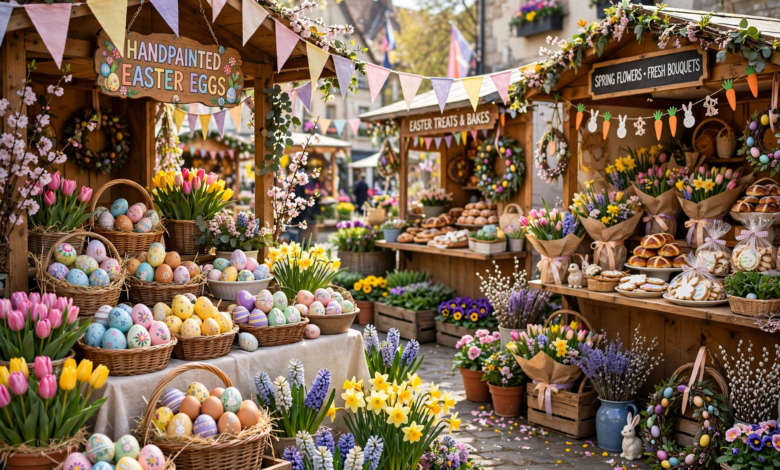
Forget everything you think you know about Easter. Beyond the chocolate eggs and Sunday roasts familiar in Britain, Easter traditions around the world take a gloriously strange turn: entire towns drench each other in water, rival churches bombard one another with homemade rockets, clay pots rain from balconies, and an entire nation spends the holiday reading murder mysteries. These are not urban legends or tourist-trap inventions. Every custom on this list is a real, living tradition, practised by real communities who would defend its strangeness to the last.


What makes Easter traditions so much weirder than Christmas ones? Christmas went global and got standardised — the same tree, the same songs, roughly the same dinner everywhere. Easter stayed local. Its rituals grew up in villages and parishes, tied to spring, to water, to fire and to food, and nobody ever ironed them into a single international format. The result is a patchwork of customs that range from the gently eccentric to the genuinely astonishing. Here are ten of the weirdest, all verified, all real.
Poland’s Easter Water War: Śmigus-Dyngus
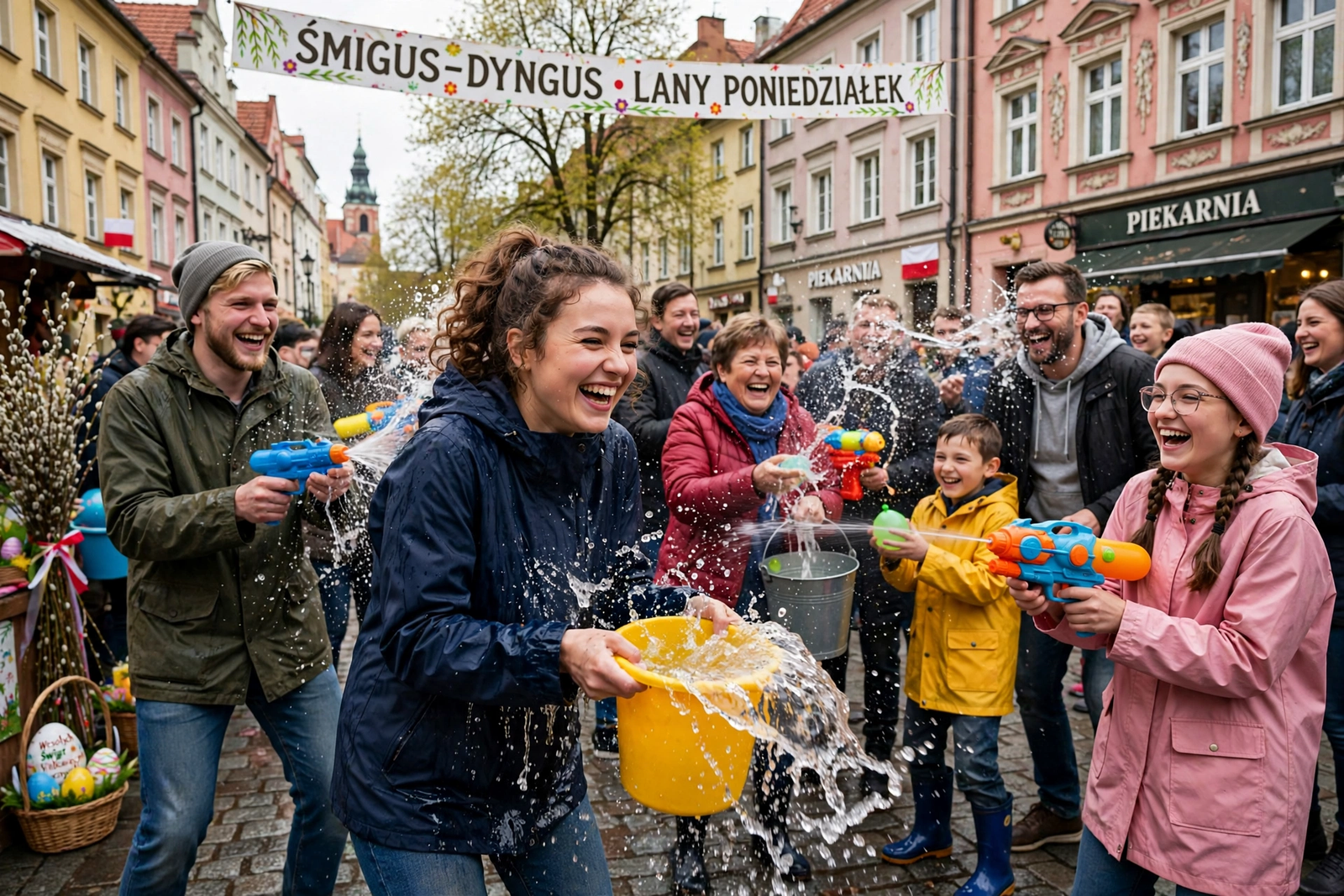
On Easter Monday, Poland turns into the world’s largest water fight. Śmigus-Dyngus — also known as Wet Monday or Lany Poniedzialek — sees friends, family and sometimes complete strangers soak each other with buckets, water pistols, garden hoses and, in the enthusiastic countryside, entire barrels of water. Nobody is safe: office workers get ambushed on their commute, grandmothers plot revenge on grandchildren, and the only sensible advice for visitors is to wear clothes you do not mind ruining. The drenching is all in good spirit, and tradition holds that being soaked brings good fortune and health for the coming year.
The custom’s roots run deep into pre-Christian Slavic spring rites of purification, when water symbolised cleansing, fertility and the washing away of winter. Over the centuries the Church absorbed the practice into the Easter calendar, and what may once have been a solemn sprinkling evolved into joyful mayhem. Girls were traditionally the main targets — being splashed was considered a sign of a young woman’s desirability and marriage prospects — though today everyone gets it equally. If you ever find yourself in Kraków or Warsaw on Easter Monday, do not be offended when a stranger empties a bucket over you. In Poland, that is practically a compliment.
Greece’s Rocket War on Chios
In the town of Vrontados on the Greek island of Chios, Easter is celebrated with what can only be described as a friendly artillery battle. Every Holy Saturday night, the congregations of two rival hillside churches — Agios Markos and Panagia Erithiani — fire tens of thousands of homemade rockets directly at each other’s bell towers. The sky fills with screaming trails of sparks, the air thickens with smoke and gunpowder, and the noise is, by all accounts, absolutely deafening. The objective is to strike the opposing church’s bell, and honour goes to whichever parish scores the most hits.
The tradition is said to date back to the Ottoman occupation, when the islanders were forbidden from firing real cannons to celebrate Easter and devised the rocket war as a defiant substitute. Whether or not that origin story is strictly true, the custom has been running in something like its current form for well over a century, surviving wars, tourism booms and periodic attempts by nervous authorities to tone it down. Thousands of spectators now crowd the rooftops and hillsides to watch, and the rocket-makers — whose craft is passed down through families — spend months preparing their arsenals. It is dangerous, it is deafening, and it is utterly unforgettable.
Corfu’s Flying Clay Pots
Holy Saturday in Corfu ends with a crash — literally. At around eleven in the morning, as church bells ring out to mark the Resurrection, the residents of Corfu Town hurl enormous clay pots from their windows and balconies onto the streets below. The pots, called botides, smash into thousands of shards across the cobblestones while crowds cheer, and the spectacle draws visitors from across Greece and beyond. Some pots are plain; others are painted, decorated, or stuffed with water for extra dramatic effect.
The symbolism is all about new beginnings: smashing the old pots represents casting off the old year and welcoming the new with a clean slate, while the shards themselves are said to bring good luck to anyone they touch. Some trace the custom to Venetian rule, when the islanders would throw out old belongings at New Year, a practice that migrated to Easter over time. Whatever its origin, the people of Corfu embrace it with total commitment — and the local council embraces it too, sending street sweepers out within the hour to clear the glorious wreckage.
Norway’s Easter Murder Mysteries (Påskekrim)
While the rest of the world hunts for chocolate eggs, Norway spends Easter hunting for fictional killers. Påskekrim — literally “Easter crime” — is the beloved national tradition of devouring detective novels, watching crime dramas and solving murder mysteries over the long Easter holiday. Publishers release new thrillers specifically timed for Easter, newspapers print serialised whodunits, and television schedules fill with detective series. For five days, one of the world’s most peaceful countries becomes obsessed with fictional murder, and bookshops report some of their best sales weeks of the entire year.
The tradition began in 1923 as a brilliant marketing stunt, when two young authors advertised their crime novel on the front pages of newspapers under the alarming headline that a famous Bergen train had been robbed in the night. Readers panicked before realising it was fiction — and a national habit was born. A century later, påskekrim is a publishing industry in its own right, with “Easter thriller” a recognised commercial category. There is even a charming logic to it: Norwegians traditionally retreat to mountain cabins for Easter, and what better way to pass a long evening in a snowbound hytte than with a good murder?
Hungary’s Perfume Ambush: Locsolkodás
Easter Monday in Hungary belongs to the boys and men, who roam from house to house armed with bottles of perfume and recite traditional verses before spraying the women of the household. The ritual, called locsolkodás — “sprinkling” — ends with the women presenting the visitors with hand-decorated eggs and, often, a shot of pálinka. In its older, rowdier form, the perfume was a bucket of cold water, and in some villages the water version survives to this day, usually deployed with great enthusiasm and at very close range.
Like Poland’s Wet Monday, the custom blends Christian Easter with much older spring fertility rites: water and scent symbolise purification, health and renewed life. The verses the men recite are part of the charm, ranging from the traditional to the cheekily improvised, and the whole performance is theatrical rather than genuinely surprising — the women know exactly what is coming. Visitors are sometimes startled to be included, but the Hungarian response is always the same: it is an honour to be sprinkled, a wish for beauty and health in the year ahead, and an excuse for cake.
The Czech Pomlázka Whipping Custom
The Czech Republic and Slovakia share one of Easter’s most startling traditions: on Easter Monday, boys and men lightly whip girls and women with pomlázka — braided switches woven from young willow branches and decorated with colourful ribbons. Before you recoil, understand that this is symbolic, playful and entirely consensual within the tradition: the gentle tapping is said to transfer the willow’s springtime vitality, bringing the recipient health, youth and beauty for the coming year. In return, the women reward their visitors with kraslice, intricately hand-decorated Easter eggs.
The willow is the whole point. As one of the first trees to bud in spring, it embodies renewal and flexibility — the switch bends rather than breaks, and so, symbolically, will you. Regional variations abound: in some Moravian villages the whipping is livelier, in Bohemian towns it is barely a tap, and everywhere the decorated eggs given in exchange are genuine folk art, patterned with wax-resist designs passed down through generations. Outsiders sometimes misunderstand it, but within Czech and Slovak culture it is cherished as a joyful, flirtatious spring game rather than anything harsher.
Bermuda’s Good Friday Kites
On Good Friday in Bermuda, the sky belongs to the kites. Families spend weeks beforehand building elaborate handmade kites — traditional diamond shapes in vivid colours, often with long humming tails — and on the holiday itself, beaches and hillsides fill with colour as hundreds take flight simultaneously. The kites symbolise Christ’s ascension, and the day has the feel of a national picnic: codfish cakes, hot cross buns, beach games and that particular Bermudian conviviality that turns any public holiday into a party.
The tradition is often traced to a 19th-century Sunday school teacher who struggled to explain the Ascension to his class and launched a kite to demonstrate the concept of rising to heaven. Whether apocryphal or not, the custom stuck and grew into one of the island’s defining cultural events, complete with kite competitions judged on craftsmanship, height and creativity. For visitors, it is the perfect introduction to Bermuda beyond the beaches: a community celebration where the whole island seems to look upwards at once.
Florence’s Exploding Cart: Scoppio del Carro
Easter Sunday in Florence begins with an explosion. The Scoppio del Carro — the “Explosion of the Cart” — sees a magnificent antique cart, loaded with fireworks and pulled through the streets by white oxen, detonated in front of the cathedral in Piazza del Duomo. A dove-shaped rocket called the colombina is launched along a wire from the high altar to ignite the cart, and if it completes its flight and sets off a satisfactory bang, Florence is guaranteed a good harvest, good business and good luck for the year. A misfire, by contrast, is taken as a very bad omen indeed.
The ritual dates back to the First Crusade, when a Florentine knight supposedly brought back flints from the Holy Sepulchre in Jerusalem, and the cart itself is a 17th-century masterpiece of carved wood. For centuries the ceremony marked the distribution of holy fire to the city’s households; today it is pure civic theatre, watched by tens of thousands in the square and broadcast across Italy. The Florentines take the omen seriously — or at least, they take the party seriously — and the whole city holds its breath for the flight of the dove.
France’s Giant Omelette of Haux
In the small town of Haux in southwestern France, Easter Monday is celebrated with an omelette of truly absurd proportions. Using some 15,000 eggs, the Confrérie de l’Omelette Géante — the Brotherhood of the Giant Omelette, in full ceremonial regalia — cooks a colossal omelette in a four-metre-wide pan in the town square, then serves it free to thousands of gathered spectators. It is part feast, part folk festival, and entirely wonderful — the kind of gloriously unserious tradition that could only survive in a country that takes food this seriously.
The legend behind it involves Napoleon Bonaparte, who supposedly stopped in the region with his army, tasted an omelette so delicious that he ordered the townsfolk to gather every egg available and cook a giant one for his troops the next day. Historians are sceptical, but Haux has never let facts spoil a good story — the brotherhood was founded in the 1970s and the event now draws visitors from across France and beyond. Similar giant omelettes are cooked in Louisiana and Belgium by allied brotherhoods, making this one of Easter’s most delicious international franchises.
Australia’s Easter Bilby (and Spain’s Semana Santa)
Not every strange Easter tradition is loud. In Australia, conservationists have spent decades promoting the Easter bilby — a long-eared native marsupial — as an alternative to the Easter bunny, on the grounds that rabbits are an ecological disaster in Australia while bilbies are endangered and adorable. Chocolate bilbies now outsell chocolate bunnies in many shops, and part of the proceeds funds bilby conservation. It is a characteristically Australian solution: keep the chocolate, fix the ecology — and give the holiday a mascot that actually belongs on the continent.
Spain offers the dramatic counterpoint. During Semana Santa — Holy Week — cities like Seville stage some of the most solemn and spectacular religious processions on earth, with hooded penitents, enormous candlelit floats and marching bands processing through the streets until dawn. It is the opposite of silly, and that is rather the point of this list: Easter traditions span the full human register, from water pistols to whispered prayers, and every one of them is somebody’s most sacred — or most hilarious — day of the year.
Conclusion
What ties these ten Easter traditions together is not weirdness for its own sake but something deeper: Easter never lost its local soul. While other holidays were smoothed into global uniformity, Easter’s customs stayed rooted in specific villages, parishes and landscapes — in Polish spring water, Greek gunpowder, Corfiot clay, Norwegian cabins and Bermudian sea breezes. That is why the strange customs survive: they belong to places, and places defend what belongs to them. So this Easter, whether you are being drenched in Kraków, ducking rockets on Chios or simply reading a murder mystery in a cabin, spare a thought for the glorious oddity of it all — and maybe start a strange tradition of your own.
If all this talk of Easter escapes has you dreaming of a spring getaway closer to home, our guide to the Isle of Wight makes the case for Britain’s own multi-generational holiday island. With beaches, coastal walks and attractions to suit every generation, it is the kind of place where your own family Easter traditions — strange or otherwise — can happily take root. And who knows? A few Easters spent hunting eggs on windswept beaches and exploring rock pools might just become the tradition your grandchildren talk about.
And for more on planning the perfect family break, see our Isle of Wight holiday guide for accommodation tips, activity ideas and everything that makes the Island work for grandparents, parents and kids alike. From steam railways and coastal walks for the older generation to beaches and adventure parks for the kids, the Island genuinely caters to every age. Sometimes the best Easter tradition is simply going somewhere wonderful together, year after year, building memories that outlast any chocolate egg. Now that is a tradition worth keeping.
What is the strangest Easter tradition in the world?
There is no single official winner, but Greece’s Chios rocket war has a strong claim: two rival church congregations firing tens of thousands of homemade rockets at each other’s bell towers on Holy Saturday night is difficult to top for sheer audacity. Poland’s Śmigus-Dyngus — a nationwide Easter Monday water fight involving buckets, hoses and total strangers — runs it close for scale, while Corfu’s tradition of hurling clay pots from balconies wins on pure spectacle. For sheer dedication, though, nothing beats the Chios rocket-makers, who spend months hand-building their arsenals in family workshops for a single night of thunderous glory.
Honourable mentions go to Florence’s exploding cart, which traces its origins to the Crusades, and the Czech pomlázka whipping custom, which startles outsiders more than any other. Ultimately, “strangest” depends on your threshold for surprise — but the rocket war’s combination of danger, devotion and deafening noise makes it most people’s champion. Whichever you pick, the real lesson is that Easter’s weirdness is a feature, not a bug, of a holiday that never got standardised. That is worth celebrating — and worth travelling for, at least once in your life.
Why do Norwegians read crime novels at Easter?
Norwegians read crime novels at Easter because of påskekrim — “Easter crime” — a century-old tradition that began as a 1923 marketing stunt when two authors advertised their thriller as a real train robbery on newspaper front pages. The panic it caused turned into a national habit: publishers now release new detective novels specifically for Easter, newspapers serialise whodunits, and television fills with crime drama for the holiday week. The tradition fits Norway’s Easter rhythm perfectly, since many families retreat to mountain cabins for five days, and a long, dark evening in a snowbound hytte is the ideal setting for a fictional murder. Today “Easter thriller” is a recognised commercial category in Norwegian publishing, with dedicated marketing campaigns and some of the year’s biggest book launches timed for the holiday.
A century after that fake train robbery, the custom shows no sign of fading — if anything, streaming adaptations have given påskekrim a second life with younger audiences. There is even a charming logic that publishers understand well: a captive audience, five free days, and weather that keeps everyone indoors is the perfect commercial formula. Norway may be famous for peace, but for one week a year, it is also famous for fictional murder. It remains one of the world’s most delightful examples of an advertising stunt becoming genuine culture.
What is Śmigus-Dyngus?
Śmigus-Dyngus, also called Wet Monday or Lany Poniedzialek, is Poland’s Easter Monday tradition of drenching each other with water. Friends, family and sometimes strangers soak one another with buckets, water pistols and hoses in a nationwide water fight that is entirely good-natured — being splashed is said to bring health and good fortune for the year. Its roots lie in pre-Christian Slavic spring purification rites, where water symbolised cleansing and fertility, and the Church later absorbed the practice into the Easter calendar. Traditionally, young women were the main targets, as being drenched was considered a sign of desirability and marriage prospects; today everyone is fair game, from toddlers to grandparents.
Visitors to Poland on Easter Monday should wear waterproof-friendly clothing and take a soaking as the compliment it is intended to be. In Poland, arriving home dry on Wet Monday means nobody likes you — while arriving drenched means you have been welcomed, blessed and thoroughly included in one of Europe’s most joyful spring rituals. Pack a change of clothes, leave the good shoes at home, and embrace the chaos — it only happens once a year. You will dry off, but the memory of being joyfully ambushed by strangers will stay with you far longer.
Why do people throw pots in Corfu at Easter?
People in Corfu throw clay pots from their windows and balconies on Holy Saturday morning to symbolise new beginnings. As church bells ring for the Resurrection, residents hurl large botides — clay pots, sometimes painted or filled with water — onto the streets below, where they smash into thousands of shards as crowds cheer. The symbolism is about casting off the old and welcoming the new with a clean slate, and the shards are said to bring good luck. Some trace the custom to the island’s Venetian past, when households discarded old belongings at the new year, a practice that migrated to Easter over time. Whatever its origin, the people of Corfu embrace it with total commitment — the pots grow bigger and more decorated every year, and the crowds gathering below grow larger too.
The town council embraces it as well, sending street sweepers out within the hour to clear the glorious wreckage. For those sixty minutes, Corfu is the loudest and most joyful place in Greece, and visitors are welcome to cheer along — just remember to look up, because the sky really is falling, one beautifully painted pot at a time. It is worth planning a trip around: few travel experiences combine history, community and sheer joyful noise quite like a Corfiot Easter.
Which countries don’t celebrate Easter with a bunny?
Many countries have their own Easter symbols instead of — or alongside — the bunny. Australia famously promotes the Easter bilby, a native endangered marsupial, with chocolate bilbies funding conservation work. In parts of Switzerland it is the cuckoo that delivers Easter eggs, while in some German regions the Easter fox or Easter rooster does the honours. Orthodox Christian countries, including Greece, Russia and much of Eastern Europe, centre Easter on elaborately decorated eggs and church ritual rather than any egg-delivering animal at all. Even where the bunny appears, it is often a recent import: the Easter hare originated in German Lutheran folklore and spread through commercial culture, so much of the world’s Easter traditions developed entirely without it. From Norway’s crime novels to Bermuda’s kites, the holiday’s strangest customs need no rabbit to thrive.
The bunny may dominate the chocolate aisle, but the world’s Easter imagination is far wider — proof that the holiday’s local soul is stronger than any single symbol. Whether it is a bilby, a cuckoo, a fox or nothing at all, every culture has found its own way to mark spring’s arrival, and that diversity is exactly what makes Easter traditions worth celebrating. So this Easter, look beyond the bunny — the world’s strangest and most wonderful customs are waiting to be discovered.