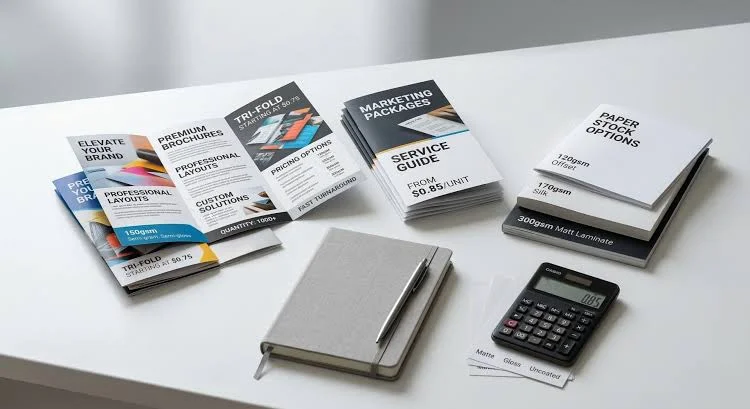
Brochure printing is difficult to budget for until you know what you are actually ordering. Two brochures with the same page count can end up at very different prices once quantity, paper, binding and finishing are taken into account.


Start with the job rather than a target price. Decide how the brochure will be used, roughly how many copies you need and when they have to arrive. From there, you can assess quotes against the same specification instead of trying to work out why two very different print jobs carry different totals.
Work out what is driving the print price
Quantity, finished size, page count, paper and binding all affect the quote. Finishing can add another layer, particularly if the job needs lamination, folding or another process after printing.
Quantity matters because the economics change as a print run grows. Some production costs happen before the first finished copy is produced, so the cost per brochure can fall when those costs are spread across a larger order. That does not mean buying more is always cheaper overall. Ordering 2,000 copies you will never use is still wasted budget.
Before requesting a quote for booklet and brochure printing Bournemouth, define the quantity, finished size, page count, preferred binding and required delivery date. Also make clear whether the artwork is ready to print or still being prepared.
If the first quote is higher than expected, change one factor at a time. Reducing the page count, choosing another stock or simplifying the finish may make more sense than cutting the quantity without considering how the brochures will be used.
Choose the print method after you know the quantity
Digital and lithographic printing suit different types of work, so deciding on the method before you know the run size can put the process in the wrong order.
Digital printing does not require printing plates and is often well suited to smaller print runs or jobs that need more flexibility between runs. Lithographic printing has more setup before production starts, but that setup cost can be spread across a larger quantity.
This is why litho may become more economical as the run grows, while digital can make more sense for smaller batches. There is no useful universal cut-off because the artwork, format, paper and printer’s equipment all affect the calculation.
Ask the printer to price the specification you actually need and recommend the production method from there. If you expect to reorder later, ask whether two smaller runs or one larger order gives you the better balance between unit cost and the risk of unused stock.
Spend on paper and binding where the brochure needs it
Paper choice affects both the price and the way the finished piece feels in the hand. Heavier stock uses more material, while coated and uncoated papers handle colour, photographs and text differently.
Do not choose paper from a description alone if appearance matters to the project. Ask whether stock samples are available and check how the design looks on the type of paper you are considering.
Binding also needs to suit the page count and purpose. Saddle stitching is commonly used for shorter brochures and booklets, while perfect binding gives thicker documents a square spine. Wiro binding can work well for manuals or documents that need to stay open during use.
For booklet printing Bournemouth projects, match the binding to the page count and the way the document will be used. A method that suits a short event programme may make little sense for a much thicker training manual.
What will the brochure have to do once it is in someone’s hands? A cover that will be handled repeatedly may benefit from lamination, while an internal handout may not need an additional decorative finish at all. Pay for finishes because they serve the job, not simply because the option exists.
Allow time for artwork checks and proofing
A fast turnaround does not help if the artwork is not ready to send. Check the printer’s requirements when preparing files for external printing, particularly the file format, bleed, page setup and colour settings.
For brochure printing Bournemouth jobs tied to an exhibition, launch or scheduled mailing, work backwards from the date the brochures must be in hand. Leave room for artwork corrections, proof approval, printing, finishing and delivery rather than treating the print date as the only deadline.
Ask what type of proof is available before approving the full run. A PDF proof can help you catch layout, spelling and page-order problems. If paper, colour or finish matters to the job, ask whether a physical proof or printed sample is available and whether it affects the price or schedule.
Check the proof carefully. Names, telephone numbers, prices, dates and web addresses are easy to skim past when you have already seen the artwork several times.
Compare the whole quote, not one headline figure
Ask each printer to quote against the same specification. Otherwise, a cheaper number may simply represent a different paper, binding method, delivery arrangement or level of artwork checking.
Ask for a quote that shows the main parts of the job, including
- quantity
- finished size and page count
- paper stock
- binding
- finishing
- proofing
- delivery
Also ask what happens if the artwork needs correction before print. Some jobs arrive ready for production, while others need changes before they can go to press. Knowing how that work is handled makes the budget easier to control.
VAT deserves a check as well. HMRC lists brochures among forms of printed matter that can qualify for zero rating, but the treatment depends on what the finished product actually is. Check the current HMRC guidance on printed matter and make sure you understand how the supplier has treated the job on the quote.
Include delivery and mailing before you settle on the format
A brochure budget does not always end when the printing is finished. If boxes need to be delivered to several offices, an event venue or individual customers, distribution can affect the final spend.
This becomes particularly relevant for custom brochure printing Bournemouth orders intended for mailed campaigns. Finished size, thickness and weight can change the postal category, so check those details before approving the format.
Royal Mail lists a Business Mail Large Letter at up to 353 x 250 x 25 mm and 750 g. Check the current Royal Mail Business Mail information before finalising a brochure that will be posted in volume.
The same principle applies even when you are not mailing individual copies. Ask where the finished brochures will be delivered, how they will be packed and whether delivery is already part of the print price.
Set the specification before you set the budget
There is no useful single price for brochure printing because the cost depends on the specification. Quantity, page count, paper, binding, finishing and delivery can all affect what you pay.
Define those details first, then ask for a quote that shows what is included. If the total is too high, adjust the parts that matter least to the job instead of cutting the specification blindly. That gives you a budget based on the brochure you actually need, rather than a headline price that does not reflect the finished job.