The right patio paving slab depends on the look you want, how much upkeep you will accept and your budget, with the first real decision being natural stone, porcelain or concrete. Each material behaves differently underfoot, weathers differently and costs differently to buy and lay. Getting the choice right at the start saves the far larger cost of relaying a patio that stains, cracks or fades within a few years.

Natural stone, porcelain or concrete: the first decision
Paving slabs fall into three broad families, and choosing between them frames every later decision about colour, cost and maintenance. Natural stone is quarried and cut, porcelain is a fired ceramic tile, and concrete is moulded from cement and aggregate. Each has a distinct balance of appearance, durability and price.
Natural stone gives the most authentic, characterful finish because no two slabs are identical, and it suits traditional and cottage gardens especially well. The trade-off is porosity: most natural stone absorbs water, so it can stain and grow algae unless it is sealed and kept clean. Porcelain sits at the other end, being non-porous, frost-proof and almost maintenance-free, with a uniform factory finish, though it costs more and demands precise laying.
Concrete paving is the budget choice and the most consistent in size and colour, since it is made in moulds rather than cut from the ground. Modern concrete slabs are often textured or stamped to mimic natural stone, which narrows the visual gap, but they can fade over time and rarely match the depth of a genuine stone surface. Weighing these three families against your priorities is the sensible starting point before looking at individual products.
Natural stone paving options
Natural stone paving covers several stones, and the most widely laid in UK gardens are sandstone, limestone, granite and slate. They share the natural, varied look that defines stone paving but differ sharply in hardness, porosity and price. Understanding those differences is what lets you match the stone to the garden and the budget.
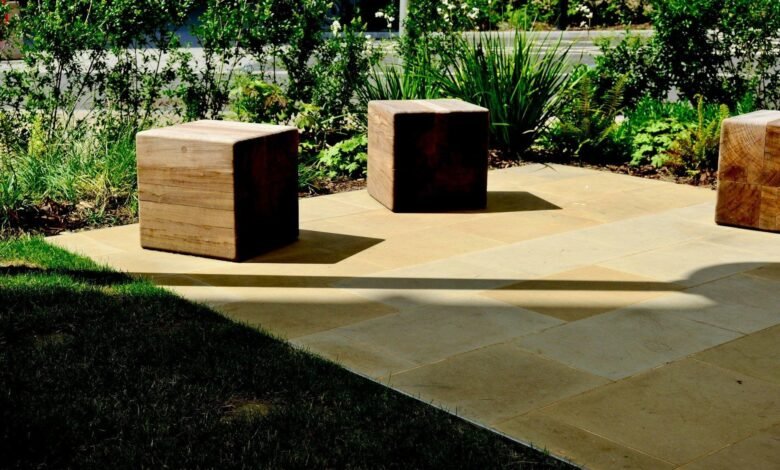
Indian sandstone is the most popular natural stone for patios, prized for its warm, varied colouring and its relatively low cost among natural stones. Quarried mainly in the Rajasthan region of India, it is sold with a natural riven surface in shades that run from the cool tones of Kandla grey through raj green to the warm browns and buffs of autumn and modak. Because it is a sedimentary stone it is porous, so Indian sandstone paving slabs absorb water and benefit from sealing to resist staining and algae. It is usually supplied in mixed-size project packs that cover a set area, which makes it straightforward to lay a random patio pattern.
Limestone offers a smoother, more uniform surface than sandstone and a more contemporary look, but it is similarly porous and needs the same care. Granite is the hard, dense option, with very low water absorption and excellent durability, which is why it costs more and is chosen where a patio must take heavy wear. Slate gives a dark, dramatic finish with a fine riven texture, though softer slates can flake at the surface over time. The choice between them comes down to how much you value hardness and low maintenance against the warm, forgiving character of sandstone.
Porcelain paving
Porcelain paving is a fired ceramic slab that is non-porous, frost-proof and highly resistant to stains, making it the lowest-maintenance option. It is manufactured to precise sizes with a consistent surface, so a porcelain patio looks uniform and modern rather than natural and varied. For a clean, contemporary garden that needs little upkeep, it is increasingly the material of choice.
The performance advantages are real. Because porcelain barely absorbs water, it does not need sealing, resists algae far better than stone and shrugs off wine, oil and leaf stains that would mark sandstone. Good porcelain paving is also colour-stable, so it holds its appearance for years without fading, and slip-rated finishes are available for outdoor use where a smooth tile would be dangerous when wet.
The trade-offs are cost and installation. Porcelain sits at the higher end of the price range and is harder to cut, needing a diamond blade, so labour is more involved. It also must be laid on a full mortar bed with a priming slurry on the back of each slab to bond properly, because the dense surface will not grip mortar on its own. Where budget allows and low maintenance is the priority, that extra care at laying pays back over the life of the patio.
How much paving you need and what it costs
The amount of paving you need is the patio area plus a cutting and wastage allowance, and the cost is driven by the material choice more than anything else. Measuring accurately at the start prevents both the delay of running short mid-project and the expense of over-ordering slabs you cannot return.
Work out the area by multiplying the patio length by its width in metres, then add roughly ten per cent for cuts, breakages and the offcuts that random-pattern laying inevitably produces. For an irregular shape, split it into rectangles, calculate each and add them together. Natural stone sold in project packs states the coverage per pack, so you divide your total area by that figure and round up to whole packs.
On cost, the material sets the order of magnitude. Concrete slabs are generally the cheapest, Indian sandstone is the most affordable natural stone, limestone and slate sit a little higher, and granite and quality porcelain are the most expensive per square metre. Remember that the slabs are only part of the total, and the following items add to the bill on top of the paving itself:
- Sub-base aggregate: the MOT Type 1 that forms the compacted foundation under the whole patio.
- Sand and cement: the mortar the slabs are bedded on.
- Jointing compound: the material used to point the gaps between the slabs once laid.
- Sealant: needed for porous natural stone such as sandstone and limestone, though not for porcelain or granite.
- Labour: usually the largest single cost if you are not laying the patio yourself.
Because prices move with supply and season, confirm current rates with a supplier before finalising a budget.
How to lay and seal paving slabs
Paving slabs are laid on a compacted sub-base and a full mortar bed, set to a slight fall for drainage, then jointed and, for natural stone, sealed. Skipping or rushing the base is the most common cause of a patio that sinks, cracks or holds water, so the groundwork matters more than the laying itself.
Start by excavating to allow for the build-up, then work through the stages that decide whether the patio lasts:
- Compacted sub-base: lay and compact MOT Type 1 aggregate first to give a firm, level foundation that will not sink.
- Full mortar bed: bed each slab on a solid bed of semi-dry mortar, never on dabs under the corners, which leave voids that crack the slab and let water sit underneath.
- Fall for drainage: set the surface to a fall of around 1 in 80 away from the house so rainwater runs off rather than pooling.
- Even joints: keep the joints consistent at roughly ten to fifteen millimetres and tap each slab level with a rubber mallet as you go.
Two finishing steps protect natural stone in particular. Brushing a wet cement-based priming slurry onto the back of each slab before bedding helps it bond and stops water tracking up through the stone, which reduces staining and the pale marks known as efflorescence. Once the joints are pointed with a suitable jointing compound and the patio has fully dried, sealing porous stone such as sandstone or limestone guards against stains and slows algae growth. Porcelain and dense granite need no sealing, which is part of their lower-maintenance appeal.
How to choose the right paving
The right paving is chosen by settling appearance, maintenance and budget in that order, then matching a material to all three. Leading with a single factor, usually price, is what leaves people with a patio that looks wrong for the garden or demands more upkeep than they expected.
Decide first on the look. For a warm, natural and traditional patio, sandstone or limestone fits best; for a sleek modern finish, porcelain or smooth granite suits better; for a budget scheme, textured concrete does the job. Then weigh maintenance honestly: porous stone rewards you with character but asks for periodic cleaning and sealing, whereas porcelain and granite stay close to maintenance-free. Finally set the material against your budget, remembering to include the base materials and labour, not just the slabs.
If two options seem close, think about how the patio will be used. A shaded, damp corner favours a non-porous slab that resists algae, a high-traffic route favours hard-wearing granite or porcelain, and a large area on a tight budget favours affordable sandstone or concrete. A paving supplier can advise on the right product and quantities once you know the area and the priorities for your garden.