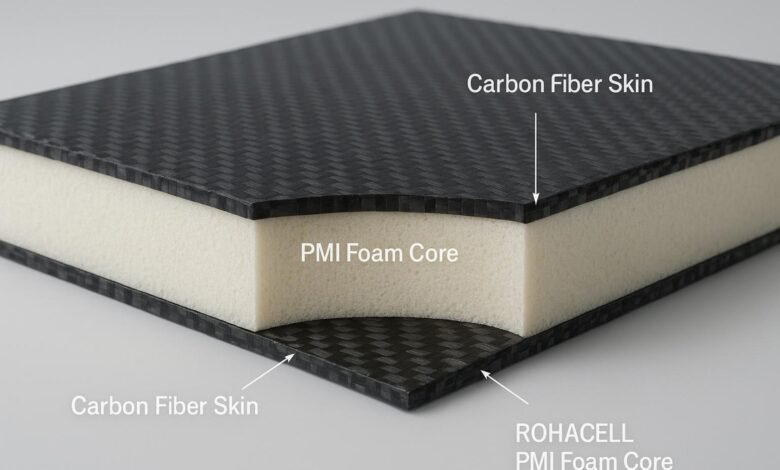
Making lightweight parts that still handle high loads is a common goal in areas like aerospace and automotive. A big part of that success often comes down to the core material. For many engineers and designers, ROHACELL PMI foam is a strong choice. This structural foam is widely used as the core in lightweight sandwich panels that need strong shear and compressive strength, even at high temperatures.


Because it works across many designs and processes, it has become a key material in modern composite manufacturing. If you want to learn more about high-performance core materials, you can find information and products, including ROHACELL PMI foam, that are helping shape new composite parts.
This article explains what ROHACELL PMI foam is, what makes it different, why it is used so often in composites, where it is used, and how it can make manufacturing easier. It also covers design points, testing, and comparisons with other core materials, so you can see why ROHACELL remains a common pick for advanced sandwich structures.
What Is ROHACELL PMI Foam?
ROHACELL is a polymethacrylimide (PMI) structural foam used in composite parts. It is a 100% closed-cell rigid foam made to give a balanced set of properties that are needed in high-performance builds. Compared with many common foams, ROHACELL has a controlled internal cell structure that helps it perform in a steady, predictable way in finished parts.
Key Properties of ROHACELL PMI Foam
ROHACELL PMI foam stands out because it is light but still strong. Different grades come in low densities, usually from 32 to 200 kg/m², which helps designers hit tough weight goals while keeping good strength. It also offers strong mechanical performance, including high shear and compressive resistance, and it keeps these properties even when temperatures rise. Its heat and creep resistance also supports faster curing for composite parts.
ROHACELL is also very stable over repeated loading, with good fatigue resistance. Since it is closed-cell, it helps prevent problems like water absorption, freeze damage, and skin debonding that can happen with other cores over time. Because it is isotropic and rigid, it gives steady support across many temperature conditions, helping provide a strong stiffness-to-weight ratio. At normal temperatures it also provides good mechanical and insulation behavior. Typical thermal values include a glass transition temperature around 202°C and an initial decomposition temperature above 300°C.
How ROHACELL Differs from Other Structural Foams
For many years, sandwich panels often used PVC (polyvinyl chloride) and PET (polyethylene terephthalate) foams. These foams worked well in areas like marine and wind energy, especially in the 1970s and 1980s, but they had limits. One major limit was heat: many of these foams begin to soften around 70-80°C, while aerospace curing often goes past 120°C in an autoclave.
ROHACELL, based on PMI chemistry, changed what foam cores could handle. Developed by Evonik as a closed-cell rigid foam, it uses a different polymer structure that gives higher mechanical and thermal performance. ROHACELL can handle heat up to about 200°C, and some grades can take autoclave pressure at 180°C. It also has stable compressive creep behavior for processing at about 0.7 MPa and 180°C, so it keeps its shape under conditions that would crush many other foams.
Another key difference is resin uptake. ROHACELL is made for very low and very predictable resin absorption, helped by its closed-cell structure and uniform micro-cells. PVC and PET cores can take in more resin, which adds unwanted weight and increases cost. ROHACELL also has a naturally dense surface skin that helps limit porosity, so resin interaction stays shallow and controlled instead of forming resin-rich zones or internal resin paths.
Why Use ROHACELL PMI Foam in Composites and Sandwich Structures?
Using ROHACELL PMI foam in composites and sandwich panels can improve weight, performance, and durability. Its material behavior gives real advantages in both design and production, which is why it is used across many industries.
Benefits for Lightweight Design
Lightweight design matters in many advanced products, and ROHACELL supports this well. As a sandwich core, it helps lower part weight while still keeping good strength. Since it comes in densities from 32 to 200 kg/m², designers can choose a grade that matches their strength and weight needs. PMI foam can also be very light (about 0.04-0.08 g/cm³), often lighter than many metal foams. Lower weight can mean better fuel use in aircraft, better vehicle performance, and more efficient wind energy systems.
Thermal and Mechanical Performance Advantages
ROHACELL is not just light; it also performs well under heat and load. It keeps high shear and compressive strength at higher temperatures, which helps during high-temperature curing and in hot service conditions. Because it resists creep and keeps its shape under heat and pressure, it reduces the risk of core collapse or distortion during processing.
Its polymer structure includes imide groups that help it stay stable during co-curing with composite skins. It also works well in very cold conditions. ROHACELL can keep strong mechanical behavior down to about -150°C, and compressive strength and stiffness can even be higher than at room temperature. This wide temperature range and strong creep resistance make it a reliable core for parts that see tough environments.
Chemical and Environmental Resistance
ROHACELL’s closed-cell structure helps it resist moisture and chemicals. Since it does not readily absorb water, it helps avoid water ingress, freeze damage, and debonding over time. This is useful for marine parts, aerospace parts, and other uses where humidity and temperature changes are common.
Compared with metal foams, ROHACELL can also hold up well in acidic, salty, or humid environments. This helps the composite part keep its strength and performance even when exposed to harsh conditions for long periods.
Grades and Customization Options for ROHACELL PMI Foam
Evonik offers a wide ROHACELL product range with many grades made for different needs. This variety helps engineers pick a version that fits their process, performance targets, and service environment.
Overview of Available Densities
ROHACELL grades typically cover densities from 32 to 200 kg/m². This range lets users pick different cell sizes and densities to match strength, stiffness, and weight goals. Since density and cell structure affect performance, having many options helps fine-tune a design for both performance and cost.
Specialty Grades for High-Temperature Applications
Some ROHACELL grades are made for higher heat conditions. The ROHACELL WF series is widely used in aircraft structures and can meet strict MIL and CMS requirements. It is common in parts like stringer-stiffened panels and helicopter rotor blades.
For even higher temperature processing, ROHACELL XT can handle curing temperatures up to 240°C in pressureless post-cure steps, which fits BMI resin systems used in military and space projects. ROHACELL XT-HT can work at about 190°C and 0.7 MPa after a specific heat treatment. Other high-temperature grades, such as HERO and HT, are made to keep closed-cell stability during high-temperature cures and to limit resin penetration under strong autoclave conditions.
Tailoring Foam Properties for Specific End-Uses
The wide range of ROHACELL grades comes from changes in cell size, density, and post-treatment steps, so each type fits certain needs. For example, ROHACELL RIMA has very fine cells and very low resin uptake (about 50 g/m²), which helps when low weight and strong signal transmission are needed.
ROHACELL IG-F has a more open structure that is easy to machine and still performs well. For RF-transparent parts like antenna radomes, medical imaging tables, and electronics housings, ROHACELL HF is often used. It has a low dielectric constant and a fine cell structure, which helps reduce signal loss and keeps parts light. This selection of grades helps designers match the foam to the job rather than forcing one foam to fit everything.
Major Applications of ROHACELL in Composite and Sandwich Structures
ROHACELL PMI foam is used in many industries where weight, strength, and long service life matter. It works well in many composite and sandwich structures because it balances mechanical strength with thermal stability and low resin uptake.
Aerospace Components
Aerospace has used ROHACELL for more than 40 years. It is used as a core in lightweight sandwich parts for satellite launchers, helicopters, and commercial aircraft. Common uses include stringer-stiffened panels, pressure bulkheads, and helicopter rotor blades, where strong shear and compressive strength matter.
It is also used in fairings, covers, doors, window surrounds, overhead bins, floor and ceiling panels, beams, frames, cargo liners, food and drink trolleys, and cowlings. It has also been used as spherical sealing frames for Airbus A380 and A340 aircraft.
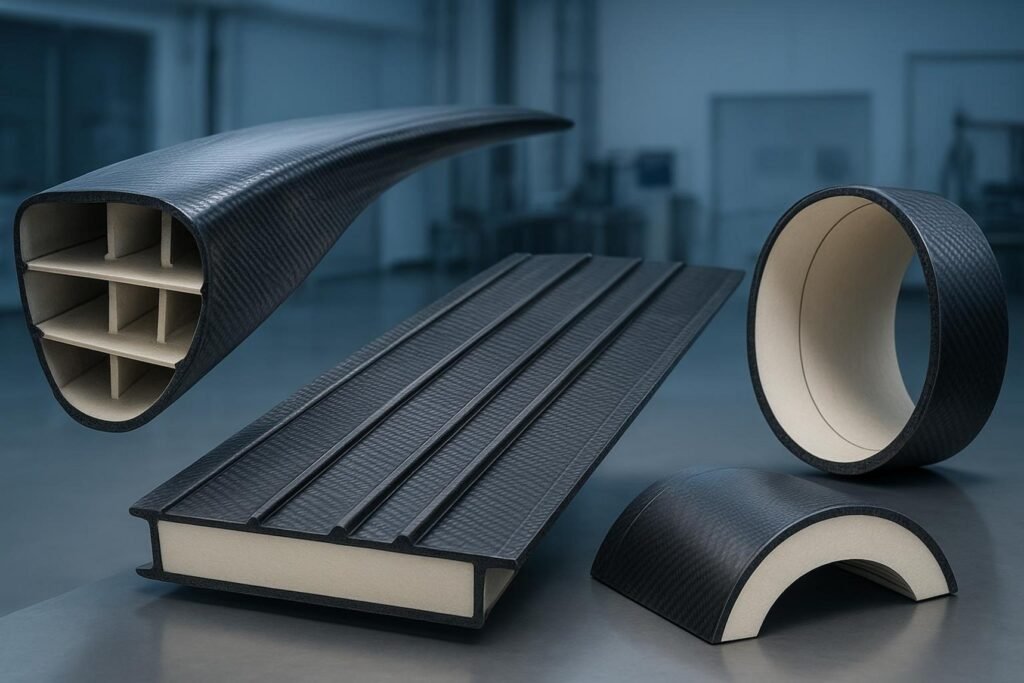
ROHACELL is also used in UAV structures, where carbon fiber/PMI foam sandwich layouts can handle mixed impact loads. Because it stays stable at very low temperatures, including exposure to liquid hydrogen (-253°C) and liquid oxygen (-183°C), it can also fit cryogenic tank designs in launch vehicles. Foam-filled stringers using PMI foam can also improve buckling resistance compared with hollow stringers, helping avoid early failure in parts such as rear pressure bulkheads.
Automotive Body Structures
Automotive manufacturers have also used ROHACELL for around 40 years, mainly to reduce weight and improve efficiency and safety. It is used in body structures such as floor parts and engine hoods. Research shows CFRP hoods with a PMI foam core can lower pedestrian injury risk during a collision. ROHACELL can also be shaped into complex 3D forms, which supports more design options in vehicles.
Marine and Wind Energy Applications
ROHACELL works well in marine and wind energy uses because it resists water and holds up under repeated loads. In marine structures, it can be used in lightweight hulls and other parts where water ingress resistance matters. In wind power, it is useful in large turbine blades, where its high strength-to-weight ratio and dimensional stability help blades last longer under changing loads and temperatures.
Sports and Leisure Equipment
ROHACELL is also used in sports and leisure products like tennis rackets, skis, and surfboards. It can provide stiffness while also handling repeated impacts. Its fatigue resistance helps equipment keep its feel and structure during long-term use.
Electronics and Antenna Substrates
Electronics and antenna applications often need RF transparency and stable dimensions. ROHACELL is used in lightweight sandwich designs for electronic parts and antenna substrates. ROHACELL HF is often chosen for antenna radomes, medical imaging tables, and electronics housings because of its low dielectric constant and fine cell structure. It supports strong transmission performance, with ultralow dielectric loss (tan δ = 0.006-0.008 at 10 GHz) and high wave transparency (>95%) in the X band (8.2-12.4 GHz).
How ROHACELL Improves Composite Manufacturing Processes
ROHACELL does more than improve final part properties. It can also make manufacturing easier by supporting common shaping methods, reducing resin waste, and working with many composite processes.
CNC Machining and Thermoforming Capabilities
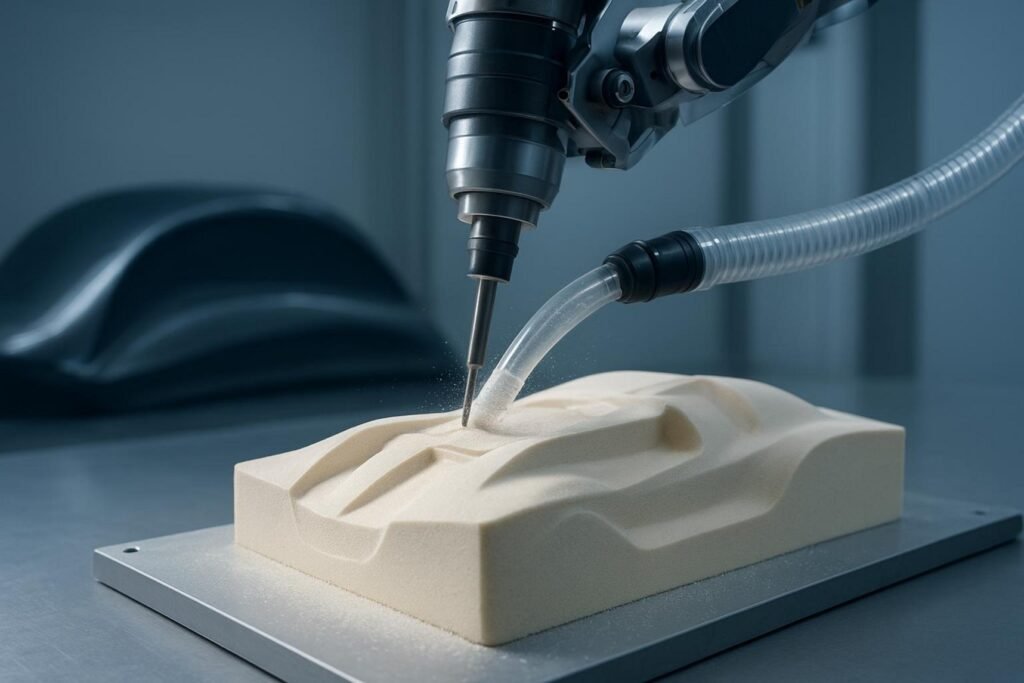
ROHACELL is easy to process. It can be shaped on standard CNC machines to make detailed geometries with tight tolerances. It can also be thermoformed in minutes, and it does not need special outgassing steps or extra surface preparation. This helps shorten cycle times and simplifies making parts with 3D curves, such as boat hulls, rocket fairings, and aircraft bulkheads.
Because it resists heat and creep, ROHACELL can also handle faster cures at higher temperatures. It can be processed in autoclaves under conditions similar to solid laminates, without the common risk of core collapse or shape drift. This makes production more stable and repeatable.
Low Resin Uptake and Its Impact
ROHACELL is made for low and predictable resin uptake. This comes from its closed-cell structure, uniform micro-cells, and controlled production. Instead of resin flowing deep into the foam, resin interaction is mainly limited to the surface and shallow penetration. This helps avoid resin-rich areas and internal resin channels that can add weight and reduce performance.
Low resin uptake leads to several practical benefits:
| Manufacturing result | Why it matters |
| Lower final part weight | Less resin “soaks in,” so there is less extra mass |
| More predictable material use | Resin and laminate weight can be estimated more accurately |
| Improved surface quality | Helps keep smooth surfaces even with thin skins |
| Strong bonding without flooding the core | Enough resin stays at the interface for adhesion |
Overall, this controlled resin behavior can cut waste and help lower total manufacturing cost.
Compatibility with Prepreg and Infusion Technologies
ROHACELL works with many composite methods, including prepreg, resin infusion, and press molding. It can cure in autoclaves, and it also works well with infusion and wet layup when resin content and surface conditions are controlled.
Prepreg systems are often used with ROHACELL because prepreg has consistent resin levels, and ROHACELL can tolerate the heat and pressure of curing. Infusion also works well because the closed-cell foam limits resin absorption and keeps resin flow focused in the laminate layers.
Design and Processing Considerations When Using ROHACELL PMI Foam
To get the best results with ROHACELL, you need to plan both design and processing carefully. Picking the right grade and staying within process limits helps you get the performance you expect.
Optimal Structural Design for Sandwich Layouts
Using ROHACELL well means selecting a grade that matches the job. Higher-density grades can help where stiffness and low deflection are needed, while lower-density grades help where minimum weight matters.
Because PMI foam is isotropic and easy to machine, you can also build complex core shapes that help reduce local buckling in face sheets. This supports complex 3D designs like boat hulls, rocket fairings, and aircraft bulkheads. Finite element simulations are often used to check the design under expected loads and confirm that the core shape and density support the full structure.
Influence of Processing Parameters on Final Properties
Final part quality depends strongly on processing details such as resin viscosity, cure temperature, applied pressure, and the foam surface after machining. Even though ROHACELL has low resin uptake, very low-viscosity resin combined with high pressure can still push resin further than expected if the process is not controlled.
Each ROHACELL grade has recommended processing limits. If you go outside them, the foam can yield or collapse under heat and pressure, which can lead to core cracking or debonding between the core and face sheets. Good process control and following the grade guidance from a supplier like Chem-Craft help avoid these issues.
Best Practices for Bonding and Lamination
Bonding quality is a major part of sandwich panel performance. Epoxy resins are often used because they work well with PMI foam and many fiber types. Low-viscosity epoxy systems (such as LH group resins like HAVEL’s LH-289) can help wet fabrics and remove trapped air, which helps reduce voids.
For solid ROHACELL core builds, vacuum bagging is a common method because it applies even pressure, removes extra resin, and reduces trapped air. Surface prep and controlled resin application also matter. ROHACELL’s dense outer skin and low resin uptake help bonding by keeping enough resin at the interface for a strong bond, without adding extra weight inside the core.
Quality and Performance Testing of ROHACELL Cored Sandwich Structures
ROHACELL sandwich structures are tested to confirm they meet demanding standards, especially in aerospace and other safety-focused industries.
Mechanical Strength: Flexural and Impact Testing
Testing often includes quasi-static penetration tests (QSPTs), bending tests, and impact tests. Results commonly show strong impact behavior, often beating core options like Balsa and Nomex in impact-driven cases. In some comparisons, CFRP/ROHACELL/CFRP systems reached impact values about twice those of CFRP/Balsa/CFRP (11.9 kJ/m² vs. 6.9 kJ/m²).
During impact, ROHACELL absorbs energy through local crushing and cell wall deformation, which helps spread the load. This can be especially effective when impact hits the laminate side, since CFRP skins carry tensile and compressive stresses well. Balsa can show higher bending strength and puncture resistance in some cases, but ROHACELL often performs better at absorbing impact energy, which is useful for debris strike risk or sudden loads.
Aging, Fatigue, and Environmental Resistance
Long-term durability is important in aircraft and marine parts. ROHACELL has strong creep resistance, so it keeps its shape under steady load and heat for long periods. It also has good fatigue resistance, helping reduce the risk of skin debonding over time.
Its closed-cell structure supports environmental resistance by limiting water ingress and freeze damage. It can also provide good chemical resistance in acidic, salty, and humid conditions. Research also shows PMI foam can keep stable properties even after exposure to very low temperatures such as liquid hydrogen (-253°C) and liquid oxygen (-183°C), which supports use in cryogenic systems.
Fire, Smoke, and Toxicity Ratings
PMI foams are naturally highly flammable, so many applications require strong fire, smoke, and toxicity (FST) performance. This is an area where ROHACELL variants can be improved through chemical changes, such as grafting with amino-terminated phosphorous polyborosiloxane (N-PBSi).
These changes can improve char formation, increase flame resistance, and reduce smoke. Test results have shown lower total heat release (THR) and lower peak smoke generation rates (pSPR) in modified PMI foams. These flame-retardant options help ROHACELL fit safety rules in areas like aircraft interiors.
Comparing ROHACELL with Other Foam Core Materials
Choosing a core material affects strength, weight, processing, and total cost. A clear comparison helps you pick the right core for your use.
ROHACELL vs. PVC and PET Foams
PVC and PET foams have been popular because they are cost-effective and offer decent stiffness, especially in marine and wind. But their heat limit (often around 70-80°C) makes them a poor fit for high-temperature curing, such as aerospace autoclave cycles that can exceed 120°C. They can also absorb more resin during infusion, especially in thinner sections, which increases weight and material cost. Their creep resistance under long-term load and heat is also lower, which can cause shape changes during processing.
ROHACELL provides much higher heat resistance (up to about 200°C depending on grade) and can handle autoclave pressures at around 180°C for certain grades. Its creep stability helps it keep shape during long cures under pressure. Its closed-cell structure also supports low, predictable resin uptake, which helps reduce extra weight and keeps costs more stable.
When to Choose ROHACELL Over Alternative Cores
ROHACELL is often chosen when the application needs high performance, tough processing conditions, or consistent results. It is a strong choice when:
- High-temperature processing or hot service conditions are needed: Some grades can handle about 190-240°C, which is beyond PVC and PET limits.
- Low weight is required without losing strength: Helpful in aerospace, high-performance vehicles, and UAVs.
- Low and predictable resin uptake matters: Supports consistent part weight, stiffness, and bonding.
- High shear, compression, and creep resistance are required: Useful for parts under steady load or high-pressure curing.
- Impact resistance is important: Often better at absorbing impact energy than Balsa in many sandwich setups.
- Long-term durability in harsh environments is required: Closed-cell structure helps block moisture and reduce freeze damage.
- Complex shapes and easy machining are needed: CNC machining and thermoforming allow detailed 3D cores.
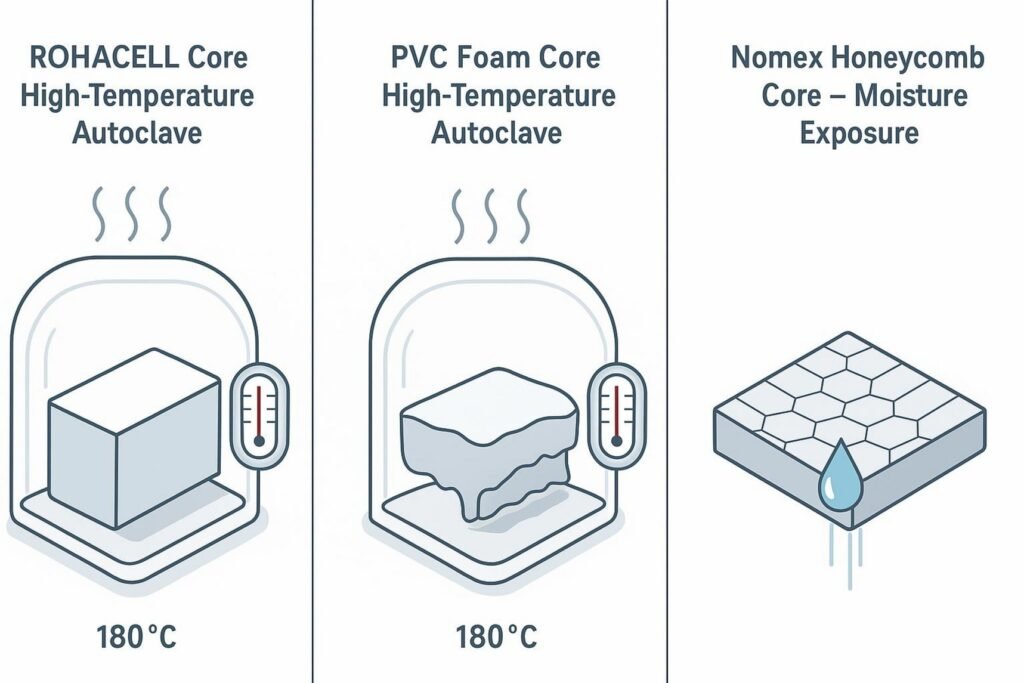
Balsa can offer strong bending and puncture resistance, but it varies because it is natural material and often has lower impact performance. Nomex honeycomb can be very light and can offer good FST performance, but it may have lower overall mechanical strength and can be at risk for water ingress if cells are open. ROHACELL gives a consistent synthetic option that works well in high-temperature, high-impact, and lightweight designs.
Frequently Asked Questions about ROHACELL in Sandwich Structures
ROHACELL is widely used, but people still ask practical questions about how it behaves in real builds. Here are common questions and clear answers.
Can ROHACELL Be Recycled or Reused?
ROHACELL PMI foam is a cross-linked rigid foam. Cross-linked polymers are generally harder to recycle in the usual way (melting and re-forming) because they do not remelt like thermoplastics. In many cases, the focus is on reducing waste during manufacturing and extending product life.
While direct recycling streams for cross-linked PMI foams are not as common as for some plastics, Evonik has also developed other acrylic-based foams such as ROHACRYL® SW, which is recyclable and thermoformable. For ROHACELL, future options may include advanced recycling methods or re-use approaches, but large-scale recycling is not as established.
What Processing Temperatures Are Safe for ROHACELL?
ROHACELL is known for strong thermal stability. Many standard grades are made for processing up to about 190°C. Some special grades, like ROHACELL XT, can handle curing temperatures up to 240°C in pressureless post-cure cases. Typical values include a glass transition temperature near 202°C and decomposition starting above 300°C.
Even with this heat resistance, processing settings still matter. If the foam sees too much heat and pressure outside its grade limits, it can yield or collapse, causing cracks or debonding. Following the grade-specific processing guidance helps prevent these problems.
How Does ROHACELL Handle Long-term Load or Impact?
ROHACELL is built for strong long-term behavior. Its creep resistance helps it keep dimensional stability under constant load and heat over long periods. This is important for aircraft and other long-life structures.
For impact, ROHACELL performs well because its closed-cell structure can absorb energy through cell wall deformation and localized crushing. This helps protect the sandwich structure and supports good fatigue performance over repeated loading. It also blocks water ingress, which helps avoid freeze-related damage. At very low temperatures (down to about -150°C), it still keeps strong mechanical behavior, including high compressive strength and stiffness.
Key Takeaways on the Applications of ROHACELL PMI Foam in Composites
ROHACELL PMI foam has changed what foam cores can do in composite and sandwich structures. It is not just a lightweight filler. It is a structural core material that helps engineers build lighter parts that still work in tough environments.
Its PMI chemistry provides a strong mix of benefits: high strength-to-weight ratio, strong heat stability, good creep and fatigue resistance, and low, predictable resin uptake. These traits support manufacturing methods and designs that are hard to achieve with traditional foam cores.
Across aerospace, automotive, marine, wind energy, sports equipment, and electronics, ROHACELL helps create parts that are lighter, more efficient, and better able to handle heat, cold, moisture, and impact. With many grades built for different needs, ROHACELL remains a key option for advanced sandwich structures used in demanding applications.