Kyle Busch died on 21 May 2026, aged 41, and the timeline of the days and months that followed explains exactly how the news broke, what his family confirmed, and how the sport said goodbye. If you are looking for the kyle busch cause of death in one place, this is the chronology: a simulator test in Concord on 20 May, his death in a Charlotte hospital the next day, a family statement on 23 May, an official death certificate reported days later, a summer of on-track tributes, and a public Celebration of Life at Charlotte Motor Speedway on 9 October 2026. Every step in that sequence is attributed below to the family statement or the death certificate as reported by the Associated Press, because those are the two sources that carry real authority in this story.


This article is deliberately structured as a timeline rather than a general explainer, so that each date stands on its own and readers can see what was known, and when it became known. That distinction matters, because early reports, family announcements and official records arrived at different moments and said different things, and collapsing them into a single summary would blur the record. What follows is the sequence of events from the final week of his racing season through to the October farewell, with the cause of death attributed to the family statement and the death certificate as reported by AP in every single mention, exactly as a sensitive story like this one demands.
20 May: The Simulator Test in Concord
The final week of Kyle Busch’s life looked, from the outside, like any other race week for a driver still competing at the highest level of NASCAR. According to the Associated Press, he had been thought to have a sinus cold while racing at Watkins Glen on 10 May, and he had even radioed his team after that race to say he needed a shot from a doctor, yet he kept racing through the days that followed. He went on to win the Truck Series race at Dover and finished seventeenth in the All-Star race five days before his death, and he also attended the opening of a go-kart track with his eleven-year-old son Brexton in that same final week. Nothing in that public schedule suggested that a medical emergency was approaching, which is part of why what happened next came as such a shock to the sport.
On Wednesday 20 May 2026, Busch was testing in a Chevrolet racing simulator in Concord, North Carolina, as he prepared for the Coca-Cola 600 at Charlotte Motor Speedway, the race scheduled for the Sunday after his death. According to the Associated Press, he became unresponsive during that simulator session and was transported to a hospital in Charlotte, and the emergency call placed late that afternoon gave a vivid and distressing picture of the scene. An unidentified caller told dispatch that he had an individual with shortness of breath who was very hot, thought he was going to pass out and was producing a little bit of blood while coughing up some blood, according to audio provided by the Cabarrus County Sheriff’s Office. The caller said Busch was lying on the bathroom floor inside the complex and told dispatch that he was awake, before giving directions to emergency responders and asking them to turn off any sirens on arrival.
21 May: His Death and the First Reports
Kyle Busch died on Thursday 21 May 2026 at a hospital in Charlotte, North Carolina, a day after becoming unresponsive during the simulator test in Concord, according to the Associated Press. He was forty-one years old, a two-time NASCAR Cup Series champion and the winningest driver in NASCAR’s three national series, with two hundred and thirty-four victories across the Cup, Xfinity and Truck Series, including sixty-three in the Cup Series itself. The family had already announced before the weekend that he would not be competing in the Coca-Cola 600 due to a severe illness, and the news of his death transformed that race from a major sporting occasion into a weekend of mourning for a driver whose career had been lived almost entirely in public.
The immediate reaction from the sport was visible on the racetrack itself, where all thirty-nine drivers in the field for the Coca-Cola 600 raced with a black number eight decal on their cars to honour Busch, according to the Associated Press report of the family statement. NASCAR chief executive Steve O’Donnell called Busch a certain first-ballot Hall of Famer and said there had even been conversation about adding him to that year’s class although the selection process had already been completed. Those two gestures, one from his fellow competitors and one from the sport’s leadership, set the tone for everything that followed: this was not a routine retirement or a quiet farewell, but the loss of a driver whose aggressive style, extraordinary record and long presence at the front of the field had made him one of the defining figures of modern NASCAR.
23 May: The Family Statement
The family statement released on Saturday 23 May 2026 is the single most important document in the story of the kyle busch cause of death, because it is the account given by the people closest to him, based on the medical evaluation they had received. According to the Associated Press report published that day, Dakota Hunter, vice president of Kyle Busch Companies, said in a news release that the family had received the medical evaluation on the Saturday, and the statement itself read that the medical evaluation provided to the Busch family concluded that severe pneumonia progressed into sepsis, resulting in rapid and overwhelming associated complications. That sentence, quoted carefully rather than paraphrased into something stronger or softer, is the full extent of the family’s public explanation of the medical sequence, and this article repeats its attribution deliberately every time the cause is mentioned.
Understanding what sepsis means helps readers grasp why a pneumonia infection could deteriorate so quickly, and the Associated Press reporting drew on the Centers for Disease Control and Prevention for that general medical context. Sepsis is considered a life-threatening medical emergency that occurs when the body has an extreme, overactive response to an infection, causing the immune system to damage its own tissues and organs, and the typical pattern involves the immune system releasing chemicals to fight pathogens before the response goes into overdrive. The results can include widespread inflammation, the formation of microscopic blood clots and blood vessels leaking, which is why sepsis is treated as an emergency in every hospital setting. The family statement itself did not go into that level of medical detail, and this article does not speculate about treatment decisions, hospital care or any factor that neither the family statement nor the death certificate actually states.
The Death Certificate: What the Official Record Says
Days after the family statement, the official record added a further layer of detail when the death certificate was obtained by the Associated Press in Mecklenburg County, North Carolina, and reported on 29 May 2026. The certificate states that Busch had been experiencing symptoms of bacterial pneumonia for days to weeks before sepsis set in, and it lists haemorrhagic shock and disseminated intravascular coagulation, commonly abbreviated as DIC, as the final causes of death, with the manner of death recorded as natural. The certificate also said that Busch, who was forty-one, was cremated in Mooresville, North Carolina, following an autopsy, and those administrative details matter because they confirm that the death was formally investigated and recorded through the normal official channels rather than left to rumour or speculation. For readers following the kyle busch cause of death, the certificate is therefore the document that turns a family summary into a precise medical sequence.
The relationship between the two sources is worth stating plainly, because it explains why this timeline treats them as complementary rather than competing accounts. The family statement gave the public its first authoritative summary, attributing the death to severe pneumonia that progressed into sepsis, while the death certificate supplied the underlying clinical detail, naming bacterial pneumonia over days to weeks, followed by sepsis, with haemorrhagic shock and disseminated intravascular coagulation as the final causes, and recording the manner of death as natural. Neither source contradicts the other, and neither source attributes the death to any other factor, which is why this article does not entertain alternative explanations that have no basis in either document. When a story involves a public figure’s death, the discipline of sticking to attributed, official sources is not a stylistic choice but a responsibility, and the certificate and the statement together are what make that discipline possible here.
June to September: How the Sport Responded
The summer months after Busch’s death were marked by a quieter, more personal kind of remembrance, as teams, drivers and fans found ways to honour a career that had ended suddenly in the middle of a season. As of late May, no public memorial had been announced, according to the Associated Press reporting of the death certificate, which meant that the tributes of the summer took place on the racetrack and in the racing community rather than at a single formal ceremony. That pattern is common when a death happens mid-season, because the sport itself keeps moving from track to track each weekend, and each stop becomes another opportunity for drivers, crews and supporters to acknowledge the loss in their own way. The absence of an immediate large-scale memorial did not mean the sport had moved on, but rather that the farewell would come later, when the calendar and the family allowed for something bigger.
The most visible summer tribute came in August, when it was announced that Ty Gibbs would drive a car in the multicoloured M and M’s paint scheme made famous by Busch during the NASCAR Cup Series race at Bristol the following month. Busch’s widow Samantha announced the tribute, writing on social media that Bristol was always one of Kyle’s favourite tracks, that he loved racing under the lights there, found so much success there, and that the iconic M and M’s car held some of the best memories of his career and their life together. The choice of Bristol was fitting in sporting terms as well, because Busch and the number eighteen Toyota M and M’s car were synonymous when he drove for Joe Gibbs Racing from 2008 to 2022, before his move to Richard Childress Racing in 2023, and he won nine Cup Series races and a total of twenty-three NASCAR races at Bristol. The tribute therefore connected the summer of mourning directly to the happiest chapters of his driving career, rather than only to its final week.
9 October: The Celebration of Life at Charlotte
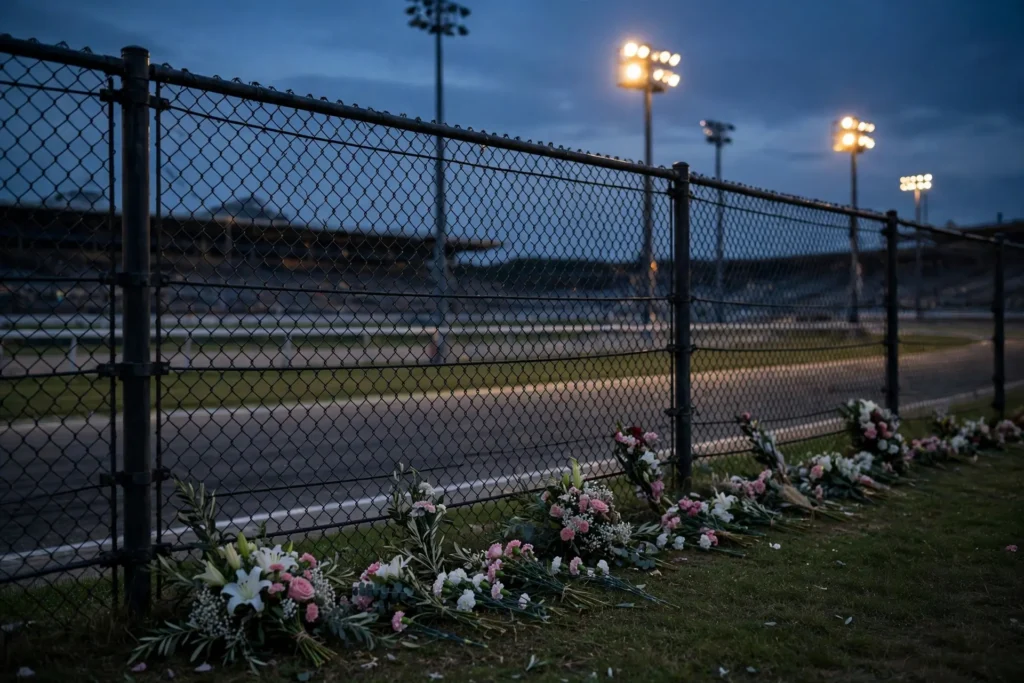
The timeline reaches its public conclusion on 9 October 2026, when a public Celebration of Life was held at Charlotte Motor Speedway and drew more than ten thousand fans, according to the Associated Press. The scale of that gathering matters, because it showed that the mourning for Busch extended far beyond his own team and immediate circle, drawing supporters, fellow drivers and teams together for a shared occasion to remember his career and his contribution to the sport. The celebration took place at the same Charlotte Motor Speedway complex where he had been scheduled to race the Coca-Cola 600 in May, which gave the event a particular poignancy: the track where his final race week had been planned became the place where thousands of people gathered to say goodbye. NASCAR also held a moment of silence at his home track in Las Vegas, according to Associated Press reporting, which underlined how widely his death was felt across the NASCAR community rather than only among his own team and fans.
The details reported from the Charlotte celebration give a sense of how personal the occasion was, even at such a large scale. According to reporting of the event, Samantha Busch told the crowd that this is not the end of Kyle’s story, and Busch’s eleven-year-old son Brexton closed the programme with burnouts in one of his father’s Cup cars before standing on the roof and taking the signature Kyle Busch bow. Those moments, a widow’s statement of continuity and a son’s tribute in his father’s car, are the kind of details that belong in a timeline because they show what the farewell actually felt like to the people there, rather than reducing it to an attendance figure. The October tributes took place months after the May family statement and the death certificate, and they form the closing chapter of this story: a driver whose career was celebrated in public, in front of thousands of people, after a death whose cause had already been stated clearly and officially.
Conclusion
Looking back across the full timeline, the sequence is now clear and complete, from the simulator test in Concord on 20 May through the death on 21 May, the family statement on 23 May, the death certificate reported on 29 May, the summer tributes and finally the Celebration of Life on 9 October. The kyle busch cause of death, as stated by the family statement and the death certificate as reported by the Associated Press, was severe pneumonia that progressed into sepsis, with haemorrhagic shock and disseminated intravascular coagulation recorded as the final causes and the manner of death recorded as natural. That attribution has remained consistent from the first family announcement to the official record, and no credible source has offered any competing account, which is why this timeline can present the cause with confidence while still attributing it properly to its sources rather than stating it as unattributed fact.
What endures beyond the medical record is the scale of the career that the timeline describes, and that is where any honest account of Kyle Busch should ultimately rest. He was a two-time Cup Series champion with sixty-three Cup victories and two hundred and thirty-four wins across NASCAR’s three national series, more than any driver in history, and his move from Joe Gibbs Racing to Richard Childress Racing in 2023 marked the final chapter of a career built on aggressive, confident racing. The October celebration at Charlotte, with more than ten thousand fans in attendance, showed how deeply that career was valued, and the timeline from May to October shows a sport that took the time to grieve properly, on the track and then together in public. That is the story this timeline was written to tell, and it is told here with the restraint and attribution that the subject deserves.
When did Kyle Busch die?
Kyle Busch died on Thursday 21 May 2026, aged forty-one, at a hospital in Charlotte, North Carolina, a day after he became unresponsive while testing in a Chevrolet racing simulator in Concord. The date matters because it anchors everything else in this timeline: the family statement followed on 23 May, the death certificate was reported on 29 May, and the public Celebration of Life did not take place until 9 October, by which point the cause of death had long been a matter of public record. Readers searching for the kyle busch cause of death should therefore treat 21 May 2026 as the fixed point from which the rest of the story unfolds, and be wary of any account that places his death on a different date or suggests that the timeline is still uncertain.
The days immediately before his death also help to explain why the news came as such a shock, because Busch had been actively racing in the weeks leading up to the simulator test. According to the Associated Press, he had been thought to have a sinus cold at Watkins Glen on 10 May, yet he won the Truck Series race at Dover and finished seventeenth in the All-Star race five days before his death, and he had been preparing for the Coca-Cola 600 at Charlotte Motor Speedway when he collapsed during testing. That context does not change the date or the cause, but it does explain the disbelief that followed the announcement, since fans had watched him compete at the highest level only days earlier and had no public reason to expect a medical emergency.
What did the family statement say?
The family statement released on 23 May 2026 said that the medical evaluation provided to the Busch family concluded that severe pneumonia progressed into sepsis, resulting in rapid and overwhelming associated complications, according to the Associated Press report of that statement. Dakota Hunter, vice president of Kyle Busch Companies, confirmed in a news release that the family had received the medical evaluation on the Saturday after his death, and that statement became the authoritative public account of the cause of death. It is important to quote that wording carefully rather than to paraphrase it loosely, because the statement attributes the conclusion to the medical evaluation provided to the family, and that attribution is part of what makes the account trustworthy.
The statement deliberately kept its focus narrow, giving the medical sequence without speculating about treatment, hospital care or any factor beyond what the evaluation concluded. That restraint is worth noting, because it is the reason this article also refuses to speculate: when the family of a public figure gives a clear, limited account, the respectful and accurate response is to report that account faithfully rather than to fill its gaps with guesswork. The death certificate later added clinical detail, listing bacterial pneumonia over days to weeks, followed by sepsis, with haemorrhagic shock and disseminated intravascular coagulation as the final causes and the manner of death as natural, but it did not contradict or expand the family’s summary in any way that would justify a different telling of the story.
What happened at the October tribute?
The October tribute was a public Celebration of Life held at Charlotte Motor Speedway on 9 October 2026, which drew more than ten thousand fans, according to the Associated Press. It was the largest public commemoration of Busch’s career in the months following his death in May, and it took place at the same speedway complex where he had been scheduled to race the Coca-Cola 600 in the week he died. The sport also held a moment of silence at his home track in Las Vegas, according to Associated Press reporting, which meant that the October remembrance was not confined to a single venue but was felt across the NASCAR community as a whole. Together, those two tributes marked the moment when private grief and public celebration came together, months after the cause of death had already been established by the family statement and the death certificate.
The most memorable moments from the Charlotte celebration were deeply personal, even within such a large gathering, and they are worth recording because they show how his family chose to remember him. Samantha Busch told the crowd that this is not the end of Kyle’s story, according to reporting of the event, and his eleven-year-old son Brexton closed the programme with burnouts in one of his father’s Cup cars before standing on the roof and taking the signature Kyle Busch bow. Those details, reported by outlets covering the celebration, capture something that attendance figures alone cannot: a family honouring a husband and father in the language of the sport he loved, in front of thousands of fans who had followed his career for decades. It was a fitting final chapter to the timeline that began in a simulator in Concord five months earlier.