Cybersecurity has become a critical priority for UK organisations of all sizes, especially as cyber threats continue to grow in frequency and complexity. Understanding the difference between Cyber Essentials and Cyber Essentials Plus is essential for businesses that want to protect sensitive data, maintain compliance, and build trust with customers and stakeholders in a competitive digital environment.


The difference between Cyber Essentials and Cyber Essentials Plus lies not only in the level of protection but also in how compliance is assessed and verified. While both certifications are designed to improve baseline security standards, they differ significantly in assurance, testing methods, and cost, making it important for organisations to choose the right option based on their needs and risk exposure.
What is Cyber Essentials
Cyber Essentials is a UK government-backed certification scheme designed to help organisations protect themselves from the most common cyber threats. It focuses on five core security controls that act as a foundation for good cyber hygiene. These include firewalls, secure configuration, user access control, malware protection, and patch management, all of which reduce exposure to basic cyber attacks.
The difference between Cyber Essentials and Cyber Essentials Plus begins with how compliance is assessed. Cyber Essentials relies on a self-assessment questionnaire that organisations complete internally before being reviewed by a certification body. This makes it an accessible and cost-effective option for businesses seeking to demonstrate a basic level of cybersecurity maturity without undergoing technical testing.
What is Cyber Essentials Plus
Cyber Essentials Plus builds on the standard certification by introducing independent technical verification. Instead of relying solely on self-assessment, organisations undergo an external audit conducted by certified security professionals who test systems, devices, and networks to ensure that security controls are properly implemented and effective in real-world conditions.
The difference between Cyber Essentials and Cyber Essentials Plus is most visible in this hands-on assessment approach. Cyber Essentials Plus includes vulnerability scanning, device testing, and system checks across endpoints and servers. This provides a significantly higher level of assurance, making it more suitable for organisations handling sensitive data or working in regulated industries.
Key Differences Between Cyber Essentials and Cyber Essentials Plus
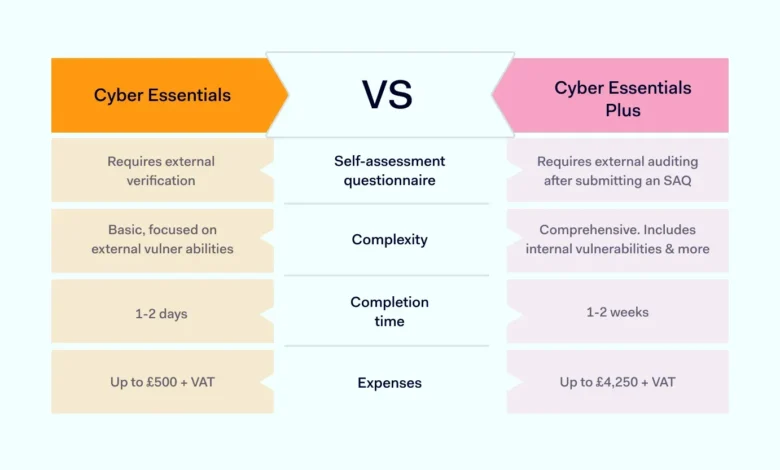
One of the most important distinctions is the assessment method used in each certification. Cyber Essentials is based on self-declaration, while Cyber Essentials Plus requires an independent technical audit. This means that Cyber Essentials Plus offers a more rigorous evaluation of an organisation’s cybersecurity posture, reducing the risk of overlooked vulnerabilities.
The difference between Cyber Essentials and Cyber Essentials Plus also extends to cost, complexity, and credibility. Cyber Essentials is quicker and more affordable, making it suitable for small businesses or those starting their cybersecurity journey. In contrast, Cyber Essentials Plus requires more preparation and investment but delivers stronger assurance to clients, partners, and government bodies.
Cyber Essentials Requirements Explained
Cyber Essentials certification requires organisations to implement and maintain five key security controls. These include securing internet connections, ensuring systems are correctly configured, controlling user access, protecting against malware, and applying timely security updates. These controls form the foundation of the UK government’s cybersecurity baseline standard.
The difference between Cyber Essentials and Cyber Essentials Plus is reflected in how these requirements are validated. With Cyber Essentials, businesses confirm compliance through a structured questionnaire, which is then assessed by an external certifying body. However, organisations must still ensure accurate implementation, as incorrect or incomplete responses can lead to rejection or delays.
Cyber Essentials Plus Requirements Explained
Cyber Essentials Plus requires organisations to first obtain Cyber Essentials certification before progressing to the enhanced level. Once eligible, an independent assessor conducts detailed technical testing across a sample of devices and systems to verify that security controls are correctly implemented and functioning as intended in real environments.
The difference between Cyber Essentials and Cyber Essentials Plus becomes more demanding at this stage, as organisations must demonstrate operational effectiveness rather than just documented compliance. This includes vulnerability scanning, system checks, and verification of security settings, making preparation more intensive and requiring stronger internal IT management.
Benefits of Cyber Essentials Certification
Cyber Essentials offers a strong entry-level cybersecurity framework that helps organisations protect themselves against the most common online threats. It demonstrates a commitment to basic security standards, which can improve customer confidence and support eligibility for certain UK government contracts and supply chain requirements.
The difference between Cyber Essentials and Cyber Essentials Plus also reflects in the level of assurance provided. While Cyber Essentials focuses on foundational protection, it helps organisations reduce the risk of common attacks such as phishing, malware infections, and unauthorised access, making it a valuable first step in cybersecurity maturity.
Benefits of Cyber Essentials Plus Certification
Cyber Essentials Plus provides a higher level of trust and validation, making it particularly beneficial for organisations that handle sensitive information or operate in high-risk industries. The independent audit process ensures that security measures are not only in place but also functioning effectively in real-world scenarios.
The difference between Cyber Essentials and Cyber Essentials Plus is especially important when it comes to credibility and competitive advantage. Cyber Essentials Plus is often required for larger contracts, particularly in government and enterprise sectors, where stronger evidence of cybersecurity resilience is necessary to meet procurement standards.
Which Certification Should You Choose
Choosing between Cyber Essentials and Cyber Essentials Plus depends on an organisation’s size, budget, risk profile, and business objectives. Cyber Essentials is ideal for small to medium-sized businesses looking to establish a strong cybersecurity foundation without the complexity of technical audits or higher costs.
The difference between Cyber Essentials and Cyber Essentials Plus becomes a strategic decision for growing organisations. Businesses that require higher assurance, work with sensitive data, or compete for larger contracts often choose Cyber Essentials Plus to demonstrate enhanced security maturity and independent verification of their systems.
Common Misconceptions About Both Certifications
A common misconception is that Cyber Essentials alone provides complete protection against all cyber threats, which is not accurate. It is designed to defend against the most common attacks, not advanced or targeted threats. Understanding this limitation is important for setting realistic expectations about cybersecurity protection levels.
The difference between Cyber Essentials and Cyber Essentials Plus is sometimes misunderstood, with some believing that Plus is simply a repeat certification. In reality, Cyber Essentials Plus involves independent testing that significantly increases the level of assurance, making it a more robust and credible certification in practice.
How to Get Certified
The certification process begins with reviewing and implementing the five core security controls required by the scheme. Organisations must then complete the Cyber Essentials self-assessment or prepare for the Cyber Essentials Plus audit, depending on the chosen certification level and business requirements.
The difference between Cyber Essentials and Cyber Essentials Plus becomes clear during the preparation stage. While Cyber Essentials focuses on documentation and self-review, Cyber Essentials Plus requires technical readiness, system checks, and remediation of vulnerabilities before the independent assessment takes place.
Conclusion
Understanding the difference between Cyber Essentials and Cyber Essentials Plus is essential for making informed cybersecurity decisions in the UK business environment. Both certifications provide valuable protection, but they serve different purposes depending on the level of assurance and risk management required.
Ultimately, the difference between Cyber Essentials and Cyber Essentials Plus lies in trust, verification, and depth of testing. Cyber Essentials provides a solid foundation for cybersecurity, while Cyber Essentials Plus delivers enhanced confidence through independent validation, making both important tools in building stronger digital resilience.
FAQs
What is the main difference between Cyber Essentials and Cyber Essentials Plus?
The main difference is that Cyber Essentials is based on self-assessment, while Cyber Essentials Plus includes independent technical testing of systems and devices.
Is Cyber Essentials Plus mandatory in the UK?
No, Cyber Essentials Plus is not mandatory, but it is often required for higher-value contracts and organisations needing stronger security assurance.
How long does Cyber Essentials Plus certification take?
The process typically takes longer than Cyber Essentials due to technical audits, often ranging from a few days to several weeks depending on readiness.
Do I need Cyber Essentials before Cyber Essentials Plus?
Yes, organisations must first achieve Cyber Essentials certification before progressing to Cyber Essentials Plus.
Which certification is better for government contracts?
Cyber Essentials Plus is often preferred or required for more sensitive or high-value government contracts.
Can small businesses apply for Cyber Essentials Plus?
Yes, small businesses can apply, but they must be prepared for a more detailed technical audit process.
Does Cyber Essentials Plus improve cybersecurity protection?
Yes, it provides stronger assurance by verifying that security controls are effectively implemented and working in real environments.